The procurement answer in one screen
The defensible answer is simple: specify android tv box hardware only after separating “PlayReady support” from the protection level required for each content path. PlayReady is a DRM system; Widevine L3 describes a device security architecture in which content processing, cryptography, and control occur outside a Trusted Execution Environment. A model merely listing “PlayReady” may still lack the OS integration, certificate provisioning, output-path controls, and operator-specific validation needed for a protected commercial deployment.
A Widevine L3 request also needs careful wording. Widevine L3 does not imply PlayReady L3: the two systems have separate implementations, trust models, and licensing paths. Procurement should require the exact device/security level, intended service, application, codec profile, output resolution, and protected-content workflow in the specification. “PlayReady optional” is not equivalent to a validated PlayReady configuration.
For DataMax, the supplied facts identify four relevant platforms. The DM21P uses AOSP Android 11 and lists Widevine L1 / PlayReady, with HDCP 2.2 optional. The DM21S, DM21T, and DM22Q use AOSP Android 14 and list Widevine L1 / PlayReady optional. These statements describe product configurations; they do not establish Widevine L3 readiness or a PlayReady security level. Any L3 demand must therefore be confirmed against the production datasheet and validated on the intended firmware and software stack.
That framework matters because content security spans the DRM client, key delivery, certificates, application binding, display output, and playback enforcement. The right question is not whether a quotation contains the words “PlayReady,” but whether reproducible evidence proves the required path. For broader platform selection, use the canonical guide to android tv box platforms for ISPs as the baseline, then apply the DRM-specific gate described below.
For a buyer, the immediate output should be a three-part requirement: an exact hardware SKU, a named software release, and a signed acceptance test. A quotation that provides only “PlayReady” or “Widevine L3” leaves all three uncertain. This distinction protects procurement from a false comparison between a catalogue label, a configured SKU, and a deployment-qualified release.
A practical procurement example shows why the distinction matters. An operator can accept a model whose PlayReady client starts, then reject the same model when it cannot request a specific license for the operator’s device profile. That failure may belong to certificate provisioning, application binding, display negotiation, or the license service, so the quotation must identify which party owns each stage. The short answer is therefore not a model number: it is a documented DRM configuration tied to one production release.
How the requirement actually works
Widevine and PlayReady sit at different points in the same commercial playback chain. An application requests encrypted media, a DRM client negotiates with the relevant license service, and the protected stream is rendered under the device’s configured security and output policy. Application logic may sit above that path, but it cannot compensate for a missing device trust mechanism or an incorrect output configuration.
Google’s architecture defines Widevine Security Level 1 as performing “all content processing, cryptography and control performed within the TEE.” Widevine Security Level 3 uses “no TEE on the device,” with protection in the host OS; a hardware crypto engine can improve performance, “not security.”
Source: Google / Widevine, Widevine DRM Architecture Overview
That distinction makes a “Widevine L3 android tv box” request narrower than it first appears. L3 moves protection into the host OS rather than the TEE. It therefore requires disciplined access control, secure boot or tamper-resistance measures, controlled software updates, protected credential storage, application-level enforcement, and a deployment process that prevents unauthorized modification. A hardware crypto engine alone does not turn a platform into L3.
PlayReady must be assessed independently. The RFQ should name the required PlayReady version and security profile, the supported device capabilities, the application and middleware integration, and the display or audio path. It should also require evidence from the intended release configuration. Without that evidence, “PlayReady” is a compatibility label, not proof that protected commercial content will operate as intended.
| Claim | What it establishes | Evidence still required |
|---|---|---|
| Widevine L1 | Google Widevine architecture level stated for the configuration | Module version, certificate status, protected playback test |
| Widevine L3 | Host-OS protection architecture rather than TEE execution | Device trust, tamper controls, update policy, validation evidence |
| PlayReady | PlayReady capability is stated | Exact version, device profile, license flow, output validation |
| HDCP 2.2 optional | An output-protection option is listed on the DM21P configuration | Whether the ordered SKU, firmware, and display path implement it |
The architecture should also identify where enforcement occurs:
For a television service, that chain includes operator middleware, entitlement handling, the device key store, trusted-device provisioning, and television or display capabilities. For a venue deployment, it may additionally include signage playlists, centrally managed devices, and physical access controls. The same DRM label can therefore pass one site and fail another because the surrounding implementation differs.
A practical example is a live IPTV channel carrying AV1 at 4K60. The application may negotiate the stream successfully, but the deployment still fails if the chosen PlayReady profile, output path, display capability, or license entitlement does not match the service profile. A second example is an OTT download workflow: live playback can pass while local storage policy, certificate validity, or offline license rules break the download use case. Testing must therefore follow the content contract, not a generic channel.
The security boundary also changes with management model. A centrally managed operator fleet can tie device identity to enrolment, signed firmware, and revocation. A retail-style deployment may depend on a distributor or installer to perform that function. The RFQ should identify who owns provisioning because a Widevine L3 claim describes an architecture, not an operational control system.
The security review should also distinguish hardware-backed key operations from host-OS controls. A supplier may show successful encryption and decryption benchmarks while leaving device identity, update authorization, or debug-access policy undefined. For an L3-sensitive design, ask which processes can access credentials, which binaries are signed, how rollback is controlled, and what happens after device replacement. These are architecture questions that cannot be answered by the Android version alone.
The platform shortlist with datasheet values
The supplied DataMax facts provide a bounded shortlist, not a Widevine L3 certification list. Each row below uses the production facts as supplied; “optional” remains optional. Do not convert it into an included feature without written configuration evidence.
| Model | SoC and OS | RAM / storage | DRM statement | Output and connectivity |
|---|---|---|---|---|
| DM21P | Amlogic S905Y4, quad Cortex-A35; AOSP Android 11 | 2GB / 8GB; 4GB; 16/32/64GB optional | Widevine L1 / PlayReady / HDCP 2.2 optional | HDMI 2.0b out x1, USB2.0 x2, TF, S/PDIF, 3.5mm AV, RJ45 100M, Wi-Fi6 2x2 + BT5.4, DC 5V/2A |
| DM21S | Amlogic S905Y5, quad Cortex-A55; AOSP Android 14 | 2GB / 16GB; 2/4/8GB; 16/32/64GB optional | Widevine L1 / PlayReady optional; Dolby Vision/DTS | HDMI 2.0b out, S/PDIF, AV, USB2.0 x2, TF, RJ45 100M (1G optional), Wi-Fi6 2x2 + BT5.4 |
| DM21T | Amlogic S905X5, quad Cortex-A510 (ARMv9); AOSP Android 14 | 4GB / 64GB; family options | Widevine L1 / PlayReady optional | HDMI 2.0b out, no HDMI in, USB2.0 x1 + USB3.0 x1, TF, S/PDIF, AV, RJ45 100M (1G optional), Wi-Fi6 + BT5.4 |
| DM22Q | Amlogic S905X5M, quad Cortex-A55 up to 2.5GHz; AOSP Android 14 | 4GB / 64GB; 2/4/8GB; 16/32/64GB optional | Widevine L1 / PlayReady optional; Dolby Vision/DTS | HDMI 2.0b out, USB2.0 x2, TF, S/PDIF, AV, RJ45 100M (1G opt), Wi-Fi6 2x2 + BT5.4 |

The same figures, in searchable form:
| Sourcing model | Editorial score |
|---|---|
| Sourcing agent | 22/100 |
| Component distributor | 35/100 |
| Factory-type OEM | 78/100 |
| Factory-type ODM | 90/100 |
The chart ranks sourcing models by how much of a field failure each model can potentially trace, not measured defect performance. DataMax’s editorial planning scale is qualitative, not audited or measured data. A factory-type ODM or OEM generally offers a more direct route to board, firmware, and process evidence than a sourcing agent or component distributor, but the ranking does not replace an audit.
The product fit also differs. DM21P is positioned for 4K IPTV and operator middleware set-top boxes. DM21S addresses 4K IPTV/OTT white-label requirements. DM21T targets premium UHD and cloud-gaming use, while DM22Q targets gaming-oriented Android TV use. None of the supplied facts records Widevine L3, a PlayReady security level, PlayReady version, certificate status, or a completed operator acceptance test. Those omissions are procurement gates, not fields to infer.
The table should be copied into the RFQ without editorial upgrades. For example, DM21P’s “2GB / 8GB” base statement and optional storage choices are separate from its DRM statement. A buyer cannot infer that an optional 16GB, 32GB, or 64GB configuration changes the DRM level. Likewise, the DM21T decode list includes H.266/VVC [email protected] 4K@120 and AV1/VP9/H.265 4K@120, but a protected service may impose a different profile or output target.
Connectivity options also require configuration control. The DM21S and DM21T facts state RJ45 100M with a 1G option, while DM22Q states RJ45 100M with a 1G opt. Those variants should appear as separate ordered configurations. A network benchmark performed on one wired variant does not automatically cover another.
Selection should begin with the deployment constraint, not the highest headline capability. An operator seeking stable middleware integration can start with DM21P and DM21S, then compare exact firmware and DRM evidence. A premium UHD or cloud-gaming requirement can point to DM21T, while a gaming-oriented service can point to DM22Q. Each direction still requires the same signed protected-content test. In every case, the quoted android tv box must retain its model identity, configuration options, and production release in the acceptance record.
Where this matters in a deployment
The deployment context determines which DRM claims matter. An operator may need a stable middleware baseline and managed entitlements; an integrator may need a fixed display and network path; a venue team may need centralized recovery and controlled physical access. The device label alone resolves none of those differences.
| Situation | Primary requirement | Model direction | Release evidence |
|---|---|---|---|
| IPTV operator | PlayReady path compatible with middleware and license service | DM21P for operator middleware; DM21S for white-label | End-to-end entitlement test on the exact image |
| OTT service | DRM client integration and selected codec/output profile | DM21S or DM21T, subject to workload fit | Application-level playback and output validation |
| Premium UHD or cloud gaming | Decode capability and a protected 4K output path | DM21T | Profile, frame-rate, and protected-content test matrix |
| Gaming-oriented service | DRM behavior plus performance under sustained playback | DM22Q | Thermal stability, input, and protected playback evidence |
| Digital signage or venue | Remote management, recovery, and controlled updates | Select from the validated platform set | Provisioning, revocation, and recovery procedure |
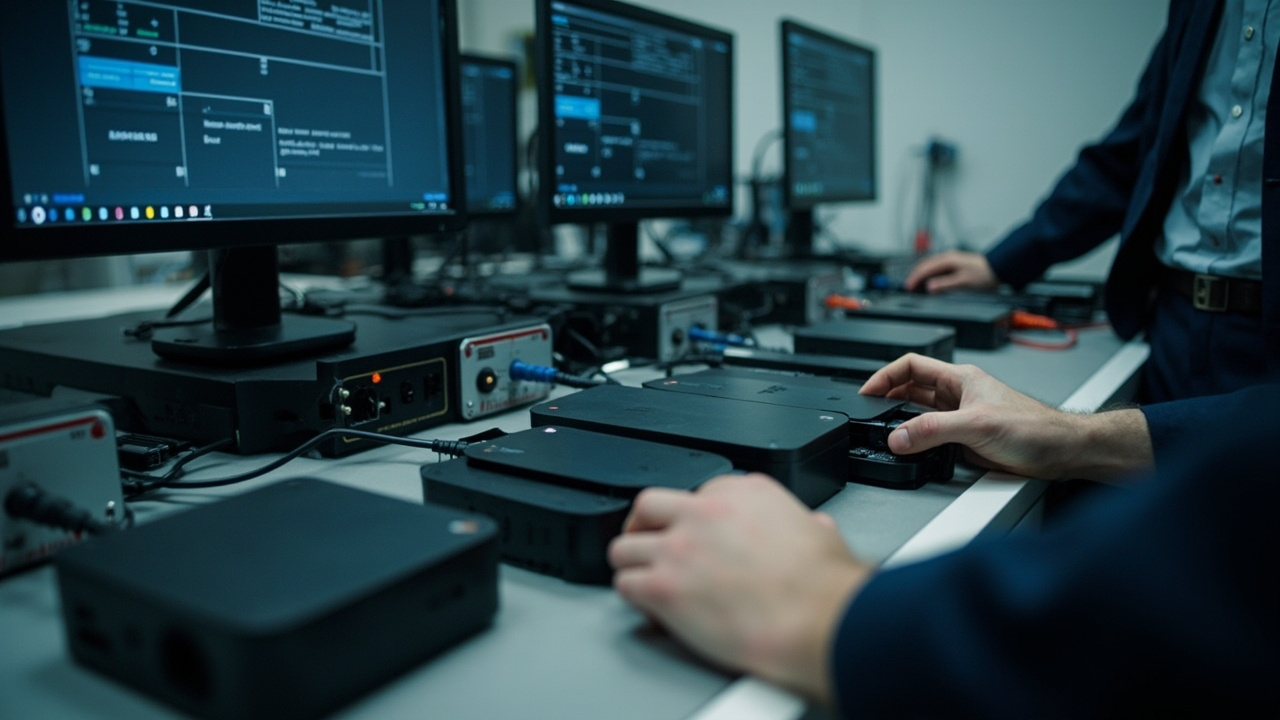
A real telecom laboratory exposes the integration work better than a generic specification sheet. Rows of set-top boxes connected through HDMI and Ethernet reveal whether a protected stream fails at negotiation, decoding, output, or playback. RF and network instruments may not directly prove DRM security, yet they help isolate whether the fault belongs to the content pipeline or the delivery environment.
For an IPTV operator, the first acceptance case is a live channel delivered through the operator middleware. The test should cover valid entitlement, rejected entitlement, license-service delay, channel join, playback, HDMI negotiation, restart, and power-cycle recovery. A second case should exercise the required codec and frame-rate profile because a successful HD channel does not prove a 4K60 or other high-bandwidth path.
For an OTT integrator, the display model and application version become part of the test fixture. One television may negotiate the intended mode while another exposes a restart problem. The integrator should therefore freeze the display model, HDMI configuration, network switch behavior, application build, and content profile in the test record.
For a venue deployment, unmanaged physical access can defeat a technically correct DRM configuration. The site plan should address mounting visibility, remote recovery, screen theft, shared accounts, firmware update windows, and local operator access. If the device is deployed in a hospitality room, the risk model differs from a locked operator set-top-box environment even when the DRM claim is identical.
The ownership boundary must also be explicit. The operator or service provider owns entitlement policy and the service integration; the device supplier owns the stated hardware, firmware baseline, and qualified configuration; the middleware or DRM application team owns its integration behavior. A blurred boundary produces an untestable claim such as “the box supports the channel” when no party is responsible for the certificate, license, or output policy.
For a managed estate, add physical and operational controls to the technical package. Record re-enrollment, lost-device revocation, signed image deployment, certificate renewal, and rollback procedures. Widevine L3’s host-OS protection model makes update control and tamper resistance part of the architecture, not an optional facilities detail.
A realistic IPTV lab test should preserve evidence from every layer. Capture the operator entitlement response, DRM client log, negotiated codec, television handshake, display mode, and restart result. If the same android tv box passes live playback but fails recorded playback, the corrective action belongs to the recording and license policy, not automatically to the hardware vendor. That ownership rule prevents unnecessary model substitution.
Turning the question into a spec line
Convert the ambiguous question into a release-specific specification. The sequence starts with content and service requirements, not a model number. It then separates DRM systems, maps the application and output path, and only then selects hardware. Finally, require evidence tied to the production configuration.
- Define the content contract Record service, codec, resolution, frame rate, audio format, output interface, and whether playback is live, on-demand, download, or recorded.
- Separate the DRM requirement Specify Widevine level, PlayReady version and security profile, certificate source, device-binding model, offline behavior, and whether each item applies to the same SKU.
- Define the platform boundary State the operating system, application, middleware, launcher, firmware release, update mechanism, and party responsible for DRM integration.
- Define the output path Identify HDMI, audio, recording, casting, docking, or external media behavior and the display capabilities that must be supported.
- Select the hardware direction Choose a DataMax platform by workload and fit, then confirm the exact configuration against the production datasheet.
- Attach acceptance evidence Require protected playback tests, failure logs, release identification, and change-control commitments to the quotation.
A pasteable RFQ line should read like this: “For the ordered [model and storage configuration], supply the exact Widevine security level, PlayReady version and device profile, DRM client source, certificate-provisioning method, supported resolution/frame-rate/codec combinations, protected HDMI and audio output behavior, and evidence from the production firmware. Identify any optional or unverified item and provide the validation plan.”
A second line should define the acceptance test: “Test [service type] using [application and middleware version] on [production image], [display model and capabilities], and [network condition]. The result must cover license acquisition, entitlement failure, stream start, 4K/frame-rate profile where applicable, output negotiation, restart, update, and recovery without substituting unprotected media.”
A third line should define the evidence chain: “Identify hardware revision, memory and storage variant, firmware image or hash, DRM module version, certificate-provisioning state, application version, test fixture, result code, and corrective action for each observed failure.” This line prevents a generic certification document from replacing product-specific validation.
A fourth line should separate included from qualified features: “List every requested DRM, display-protection, codec, wired-network, and storage option as included, optional, unverified, or excluded. Do not apply an option label to an orderable configuration unless it appears in the production datasheet and release evidence.” That wording is particularly useful when comparing quotations from factories, agents, and distributors.
Include the platform in the subject as android tv box for traceability, but avoid using that phrase as a substitute for model, configuration, and firmware identity. The first supplier message should contain the target model, ordered memory and storage, required Widevine and PlayReady levels, application stack, output profile, and requested evidence. Send that through the RFQ form so the technical question is not reduced to a feature checkbox.
The resulting specification should also identify non-functional constraints that affect protected service quality. State the acceptable startup time, recovery time after interruption, sustained-playback duration, network utilization, update window, and logging retention. These are measurable acceptance fields, not preferences. For example, a channel-change test may pass at 100M Ethernet but fail with the 1G option under the operator’s traffic profile, which means the test record must identify the network variant as part of the ordered android tv box configuration.
Where quotations quietly diverge
Quotations often differ because each supplier is answering a different question. One may confirm a DRM SDK is present; another may confirm a protected stream can play; a third may provide an L3 architecture claim; a fourth may provide an L3-validated production device. These are different evidence levels and should not occupy the same acceptance box.
Field trap
A quotation that says “Widevine L3” without identifying the device, firmware, certificate status, and validation report does not prove that the delivered android tv box supports the operator’s commercial workflow. Require the exact security-level statement and a reproducible protected-content test. Widevine L3 does not automatically establish PlayReady readiness.
The second common trap is feature dilution. “Widevine L1 / PlayReady optional” can mean that one DRM is included while the other requires a particular build, certificate, licence, or orderable configuration. The commercial consequence is not limited to procurement: the operator may pass a showroom test yet fail certificate provisioning, live playback, output protection, or fleet deployment.
Field trap
Do not infer Widevine L3 from an L1 statement, or infer a PlayReady security level from the word “PlayReady.” In the supplied DataMax facts, L1 is stated for all four models, while PlayReady is optional on DM21S, DM21T, and DM22Q. Any L3 project needs confirm against the production datasheet plus release-specific validation.
A third divergence concerns firmware identity. Two boxes may carry the same model name and storage capacity but different AOSP images, launcher builds, DRM modules, certificates, or security patches. One supplier may have tested a development image while another tested a production release. The RFQ should request a stable image identifier and a change log; if the image changes, the protected-content acceptance test should be repeated.
A fourth divergence concerns display and audio output. “HDMI 2.0b out” does not promise a particular resolution, refresh rate, HDCP capability, or restart behaviour. A protected stream can negotiate at a fallback mode, which may make a demonstration look successful while violating the commercial profile. Record the negotiated mode and the display model rather than accepting a connector inventory.
Other divergences appear outside the DRM row. An HDMI 2.0b output claim does not state negotiated resolution or refresh rate. “4K” does not identify the codec profile or frame rate. A 100M Ethernet option can affect a 4K delivery design, while a 1G option changes that engineering envelope. Storage options can affect app caching, update headroom, and recorded content policy. These details need separate acceptance fields rather than being bundled into “4K ready.”
Commercial divergence also appears in who owns failures. Ask whether the supplier, middleware integrator, or service operator holds the certificate and licenses; who maintains the signing keys; who signs firmware; how a revoked device is handled; and whether a failed device is replaced or re-provisioned. Without those assignments, “support” has no measurable boundary.
A practical way to normalize quotations is to require each supplier to complete the same evidence matrix: claimed level, production status, optionality, release identifier, test application, content profile, display fixture, result, and unresolved gap. A missing field remains “unverified”; it must not become “supported” through interpretation. This method also lets procurement compare an agent’s 22/100 editorial traceability score with a factory route’s evidence rather than relying on prose confidence.
Questions to put in the supplier review
Supplier review should follow the hardware path from component assembly to the deployed device. The objective is not a generic certificate wall; it is traceability from a failure to the process step and firmware build that can correct it.
- Trace component identity Review the SoC, memory, storage, Wi-Fi/Bluetooth, Ethernet, HDMI, and security-component sourcing records against the approved build. Any alternate sourcing must receive a regression review.
- Inspect SMT and AOI records Check stencil, solder-paste, placement, reflow, AOI, and inspection criteria for the production board revision, including failure disposition and rework traceability.
- Review aging and burn-in Correlate runtime hours, temperature cycles, power interruptions, network load, HDMI negotiation, and playback tests with each device serial number.
- Audit firmware provenance Confirm image identity, signing process, build reproducibility, module versions, certificate status, update package, and rollback procedure for the delivered release.
- Run dark-room playback Validate licensed content, entitlement denial, stream start, output negotiation, restart, update, and recovery under controlled network conditions.
- Close the evidence trail Link test results to hardware revision, firmware hash, certificate or module state, application version, and acceptance record.
For a DataMax factory review, request a video audit and release-specific evidence pack covering SMT/AOI, aging, dark-room protected playback, and configuration traceability. The factory quality process is the appropriate reference point for the evidence request, while the exact DRM result must remain tied to the ordered SKU and production firmware.
The review should test edge cases rather than repeat the golden path. Include expired or unavailable licences, denied entitlements, unsupported output modes, network interruption during startup, application crash and restart, low storage, firmware update interruption, clock mismatch where relevant, and repeated certificate or provisioning failure. The evidence record should show what was tested, what failed, how it was corrected, and whether the correction changes the release identity.
For hardware, request records by board revision rather than by model family. A Wi-Fi module substitution can affect boot behaviour or regulatory evidence; an Ethernet controller change can alter the 100M or 1G configuration; an HDMI component change can alter display negotiation. The review should identify approved alternatives, the change authority, and the regression scope. This is the practical bridge between the model datasheet and a repeatable order.
For software, request the firmware build manifest, signing procedure, update package, rollback path, module inventory, and change history. The dark-room test should use the same application and middleware versions proposed for deployment. A test performed with a generic player proves less than a test performed with the operator’s integration stack.
Ask for a live sample rather than a generic report. A sample can expose missing partition space, launcher behavior, middleware integration, and display compatibility, but it does not prove fleet consistency unless the test method and process records are reviewed. Request the exact production datasheet and written statement for every optional DRM and connectivity feature.
The review can be staged without weakening the requirement. First, approve the paper configuration and sample route. Second, run protected playback and failure-recovery tests on that sample. Third, inspect the production and test evidence for the approved build. Each stage should have a signed result and a defined action if the evidence does not match.
The supplier should also explain what happens after an image update. Require a change-impact matrix covering the DRM client, certificates, launcher, middleware interface, HDMI behavior, and update rollback. A new image may leave the model name unchanged while altering the protected-content path. For each android tv box release candidate, request a revalidation trigger and the responsible approver.
The comparison buyers actually make
Most programmes compare a lower-complexity sourcing route against a factory-backed route. The relevant differences are control, evidence, configuration, and responsibility—not a generic list of headline specifications. DataMax’s stated product configurations can support platform direction, but L3 capability remains unconfirmed in the supplied facts.
| Decision point | Entry route | Factory-backed route | Buyer evidence |
|---|---|---|---|
| DRM statement | Generic “PlayReady” or “Widevine” label | Model-, build-, and application-specific statement | Exact levels, module versions, and limitations |
| Failure traceability | Supplier or intermediary explanation | Serial-linked production and test records | SMT/AOI, aging, firmware, and dark-room evidence |
| Configuration control | Stock feature interpretation | Written order configuration and regression gate | Approved SKU, image identity, and change log |
| Application integration | Operating-system compatibility claim | Operator middleware tested on the release image | End-to-end playback and entitlement test |
| Output behaviour | Connector inventory only | Profile-specific HDMI and audio validation | Resolution, frame rate, restart, and recovery results |
| DataMax fit | Not established from supplied facts | DM21P, DM21S, DM21T, or DM22Q selected by workload | Production datasheet confirmation |
For an operator, DM21P is the direct model direction when operator middleware is the deployment centrepiece. DM21S fits an IPTV/OTT white-label requirement. DM21T suits premium UHD or cloud-gaming workloads, and DM22Q fits gaming-oriented services. These are workload directions, not DRM certifications. Any selected android tv box must be rechecked for the exact Widevine and PlayReady configuration.
The entry route can be adequate when the buyer already controls the application integration, the hardware configuration is stable, the service uses a previously validated image, and the supplier can provide reproducible test evidence. A factory-backed route becomes more consequential when the order includes custom middleware, multiple storage or network variants, fleet provisioning, protected-content qualification, or long-term change control. The correct comparison is therefore based on evidence burden, not the label “OEM” or “ODM.”
Workload selection should not outrank DRM qualification. A high-performance gaming platform with an unverified PlayReady configuration can be less suitable for a live operator launch than a platform positioned specifically for operator middleware and proven on the required profile. Conversely, a device that passes the operator’s playback test may need a separate performance review before cloud-gaming use.
A final acceptance distinction separates catalogue support from production qualification. Catalogue support says that a DRM is intended for the platform. Production qualification says that the ordered hardware revision, image, certificate state, application, display, and license flow passed a named test matrix. The comparison is strongest when each quotation uses those same terms and supplies the same evidence artifacts.
For an L3-sensitive programme, request a video factory audit or a release-specific SMT/AOI and aging evidence pack from the DataMax manufacturing discussion. Include the target model, required Widevine level, PlayReady profile, application stack, output profile, and acceptance criteria. The correct commitment is not “DRM supported,” but a documented configuration whose security claims can be tested and maintained.
Further reading
- Guide android tv box for isps
- Android TV boxes
- Rockchip Android TV boxes
- Edge computing boxes
- 4K 60fps Android TV box guide
- DataMax DM21P specifications and fit
- DataMax DM21S specifications and fit
FAQ
Can an android tv box support Widevine L3 and PlayReady at the same time?
Yes, a platform can be engineered for both ecosystems, but the evidence must be separate. Widevine L1, L3, and PlayReady are different DRM claims, and the supplied DataMax facts state Widevine L1 while PlayReady is optional on three models. Require the exact Widevine level, PlayReady version, device profile, firmware, and protected playback results for the ordered configuration.
Does a hardware crypto engine make a device Widevine L3?
No. Google describes Widevine L3 as operating without a device TEE, with protection in the host OS. A hardware crypto engine may improve performance, but it does not improve security to the L3 level. Device integrity, update control, credential handling, and the complete application path still require validation.
Which DataMax model should an operator choose for PlayReady?
Start with the deployment fit: DM21P for operator middleware, DM21S for IPTV/OTT white-label work, DM21T for premium UHD or cloud gaming, and DM22Q for gaming-oriented services. None of the supplied facts establishes Widevine L3 or a PlayReady security level. Confirm the exact requirement against the production datasheet and a release-specific test.
Is “PlayReady optional” sufficient for a commercial IPTV launch?
No. Optional means the feature needs configuration and should not be treated as included. Before launch, define the PlayReady profile, application integration, certificate or provisioning process, output behaviour, and failure handling. A protected stream test on the production image provides better acceptance evidence than a feature-list response.
What evidence should accompany an L3-sensitive quotation?
Request model and firmware identity, Widevine and PlayReady levels, configuration-control records, and reproducible protected playback results. For factory assurance, add SMT/AOI, aging, dark-room testing, and serial-to-test traceability. The DataMax editorial planning scale indicates relative traceability potential, not audited performance.
Can a DRM feature be validated on one sample and applied to the whole fleet?
A sample establishes a starting point, not fleet consistency. The approval should also cover production records, alternate-component controls, firmware signing and update procedures, certificate handling, and regression tests. Confirm the delivered configuration and obtain evidence that the same release logic applies across the batch.