

The short answer first
Google’s Widevine documentation separates Security Level 1 from Security Level 3: Level 1 performs content processing, cryptography and control within a Trusted Execution Environment, while Level 3 has no device TEE and relies on host-OS protection. Those two numbers frame the procurement decision behind this android tv box comparison, but they do not turn an Android TV box into an Apple-platform product. A box labeled “PlayReady” may satisfy a PlayReady workflow; it does not thereby support FairPlay, and an Apple TV deployment generally cannot be substituted with a PlayReady box.
For operators distributing protected IPTV or OTT content through an Android TV ecosystem, Widevine L1 and PlayReady are the practical screening points. FairPlay matters only where the service, browser, playback chain, account policy or distribution arrangement genuinely depends on FairPlay. Apple’s FairPlay Streaming ecosystem generally centers on Apple playback environments and associated app/device integration. An Android box needs a separately validated application, service, licence and playback path.
This android tv box comparison therefore has two layers. First, compare the hardware and software commitment: SoC, AOSP version, memory, decode capability, DRM and interfaces. Second, compare the procurement evidence: production configuration, security level, codec claims, HDCP version, firmware revision and service-side playback validation. A model name alone is not a DRM acceptance criterion.
Across the supplied DataMax range, DM21P is positioned for 4K IPTV and operator middleware set-top boxes; DM21S targets IPTV/OTT white-label programs; DM21T serves premium UHD and cloud-gaming requirements; and DM22Q addresses gaming-oriented Android TV programs. All four list Widevine L1 and PlayReady in the supplied facts. None is listed with FairPlay. A FairPlay-dependent project must therefore be treated as a separate validation exercise, not as an assumed feature.
The practical answer is to select against the actual service chain. If that chain uses Widevine L1 or PlayReady, compare the supplied DataMax platforms by configuration, codec coverage and interfaces, then validate the exact golden sample. If the requirement genuinely names FairPlay, no model in the supplied facts qualifies without separate platform-owner approval.
The platform shortlist with datasheet values
The shortlist below compares only the supplied production facts. Optional configurations are retained as options, while every fixed value comes directly from the DataMax product facts. For the broader commercial framework, see Android TV box for sale explained for buyers. That guide helps buyers separate general platform selection from the narrower DRM question addressed here.
| Model | SoC and compute | OS | RAM / ROM | DRM | Key interfaces |
|---|---|---|---|---|---|
| DM21P | Amlogic S905Y4, quad Cortex-A35 | AOSP Android 11 | 2GB / 8GB; 4GB; 16/32/64GB optional | Widevine L1 / PlayReady / HDCP 2.2 optional | HDMI 2.0b out x1; USB2.0 x2; TF; S/PDIF; 3.5mm AV; RJ45 100M; Wi-Fi6 2x2 + BT5.4; DC 5V/2A |
| DM21S | Amlogic S905Y5, quad Cortex-A55 | AOSP Android 14 | 2GB / 16GB; 2/4/8GB; 16/32/64GB optional | Widevine L1 / PlayReady optional; Dolby Vision/DTS | HDMI 2.0b out; S/PDIF; AV; USB2.0 x2; TF; RJ45 100M, 1G optional; Wi-Fi6 2x2 + BT5.4 |
| DM21T | Amlogic S905X5, quad Cortex-A510 (ARMv9) | AOSP Android 14 | 4GB / 64GB family options | Widevine L1 / PlayReady optional | HDMI 2.0b out, no HDMI in; USB2.0 x1 + USB3.0 x1; TF; S/PDIF; AV; RJ45 100M, 1G optional; Wi-Fi6 + BT5.4 |
| DM22Q | Amlogic S905X5M, quad Cortex-A55 up to 2.5GHz | AOSP Android 14 | 4GB / 64GB; 2/4/8GB; 16/32/64GB optional | Widevine L1 / PlayReady optional; Dolby Vision/DTS | HDMI 2.0b out; USB2.0 x2; TF; S/PDIF; AV; RJ45 100M, 1G optional; Wi-Fi6 2x2 + BT5.4 |
For an operator already managing Widevine L1 and PlayReady, DM21P offers the most specific supplied fit for an operator middleware set-top box. Its HDCP 2.2 option matters only if the selected output path requires it and the service-side protection configuration is compatible. The RFQ should name the required HDMI, Ethernet and audio configuration rather than referring to the model generically.
DM21S moves the baseline to AOSP Android 14 while retaining a 2GB / 16GB primary memory configuration. Its supplied 1G Ethernet option and Wi-Fi6 2x2 + BT5.4 connectivity make it relevant where the network transport is less constrained than the DRM subsystem. Dolby Vision/DTS appear in the stated DRM field; confirm the exact implementation and licensing position against the production datasheet and content path.
DM21T is the strongest supplied decode commitment. Its listed H.266/VVC [email protected] 4K@120, AV1/VP9/H.265 4K@120, AVS3 4K@120 and H.264 4K@60 capabilities support premium UHD evaluation. The inline AI-SR feature is also listed, but no performance target or processing result is specified. Confirm whether it is used, under which conditions, and what is protected in the source and output paths.
DM22Q lists AV1/H.265 L5.1 4K@60 and inline AI-SR, but no NPU TOPS value is stated. Do not convert its “up to 2.5GHz” CPU description into a graphics, AI or media-processing claim. Its 4GB / 64GB baseline should also be written as an exact production configuration rather than a general storage claim.
The life-cycle control follows the order rather than ending at the datasheet. DataMax describes production controls such as SMT, AOI, aging and audit evidence through its factory quality process; the buyer should obtain evidence for the exact order and firmware.
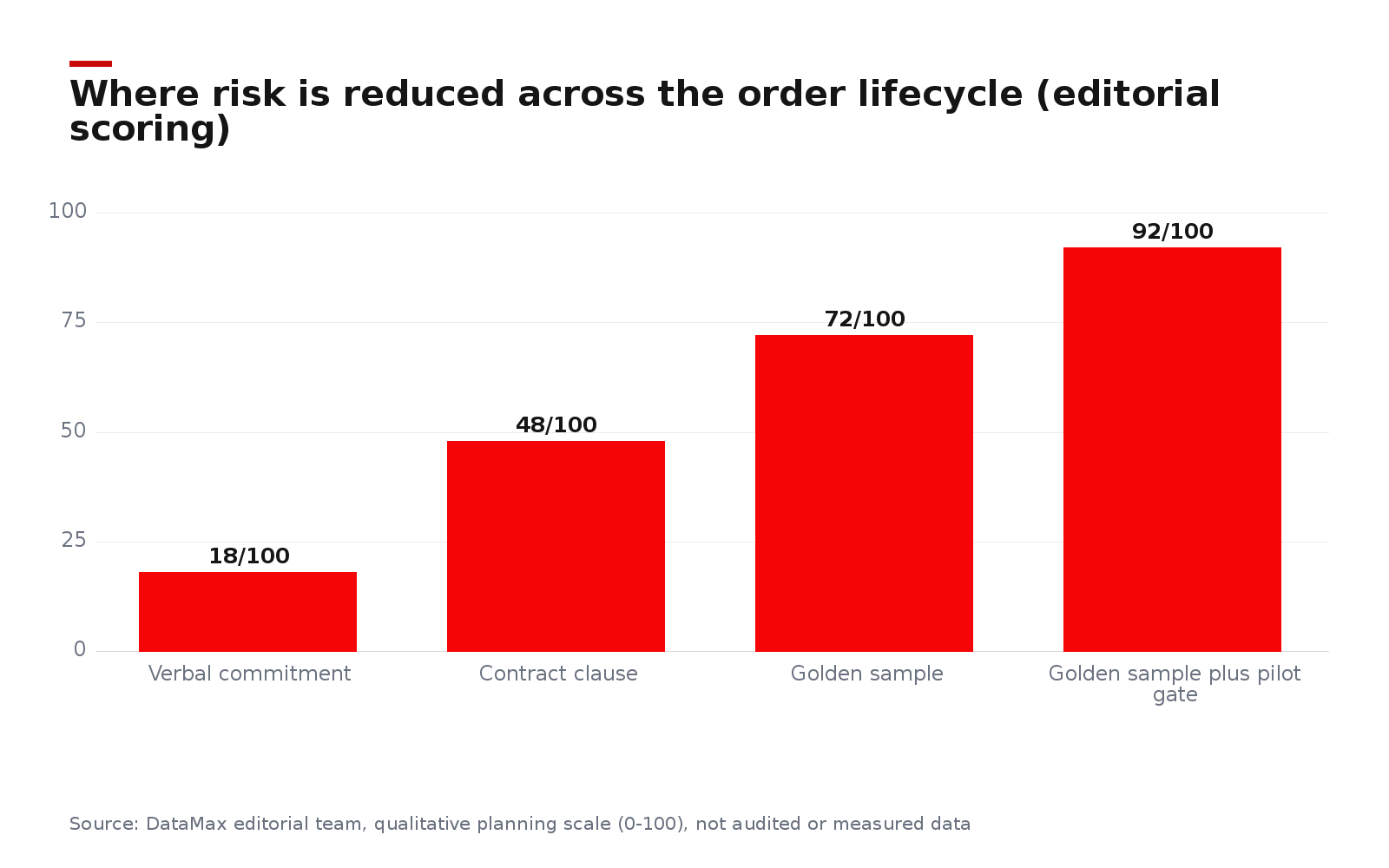
The same figures, in searchable form:
| Control option | Editorial score |
|---|---|
| Verbal commitment | 18 |
| Contract clause | 48 |
| Golden sample | 72 |
| Golden sample plus pilot gate | 92 |
Source: DataMax editorial team, qualitative planning scale (0-100), not audited or measured data.
Where this matters in a deployment
A deployment matrix prevents DRM terminology from becoming a substitute for architecture. “Operator” in the table below means a pay-TV, IPTV or OTT program team; “integrator” means an AV or IT installation business; “venue” means a digital-signage or commercial-display operation. This android tv box comparison is therefore organized by service ownership and acceptance responsibility, not only by chipset class.
| Situation | Primary requirement | Model direction | Validation condition |
|---|---|---|---|
| IPTV operator using Widevine L1 and PlayReady | Stable operator middleware, protected playback, Ethernet, S/PDIF | Start with DM21P; assess DM21S for a newer AOSP baseline | Run the actual middleware, licence service, channel package and display output on the golden sample |
| OTT white-label program | Android 14 baseline, flexible memory, dual-band Wi-Fi6 | DM21S | Confirm the selected ROM, Ethernet option, DRM configuration and application signing process |
| Premium UHD or cloud-gaming pilot | 4K@120 decode coverage, USB3.0, high-bandwidth connectivity | DM21T | Confirm service-delivered frame rate, display capability, decoder configuration and protected-content behavior |
| Gaming-oriented retail program | Android 14, 4GB / 64GB baseline, Wi-Fi6 2x2 | DM22Q | Validate game streaming, input ecosystem, thermal behavior and output mode; AI performance is not stated |
| Digital-signage venue | Managed boot, repeatable app behavior, recovery and remote operations | Choose between DM21S and DM22Q after playback and fleet-management testing | Confirm against the production datasheet; signage requirements alone do not establish a FairPlay need |
| FairPlay-dependent service | Valid application, account entitlement, playback and service integration | No DataMax model can be selected from the supplied facts | Obtain a platform-owner-approved compatibility statement before an RFQ enters model evaluation |
Operators face the clearest separation of concerns. A set-top box must decode content, obtain and maintain licences, enforce output protection and present the required UI without violating operator middleware rules. A consumer display, however, can alter the end-to-end result: an HDCP path, television settings, scaling mode and service-side restrictions all participate in playback acceptance. For multicast IPTV, the box should also be tested with the actual transport, channel join behavior and entitlement model rather than a point-to-point video file.
Integrators should avoid assuming that a physically similar box has the same production profile. A white-label model can use a different Android version, memory configuration, Ethernet option or firmware while sharing an enclosure. The exact model and configuration must be frozen on the purchase order. A useful RFQ distinguishes the operator layer, device layer, application layer and display layer, with one accountable party for each acceptance result.
Venue deployments add a fleet concern. A protected-content feature that works in a laboratory may fail after extended operation because of thermal behavior, network instability, display EDID changes or application state. The supplied DataMax facts do not state thermal limits, boot modes or fleet-management functions, so these attributes require confirmation against the production datasheet and pilot evidence. Repeated playback after network loss and power restoration is more useful than a single successful launch.
Rows of identical compact black Android TV boxes on warehouse shelving with neutral packaging, pallets and packing station in background, soft industrial light, photorealistic product journalism, no readable text, no brand logos.
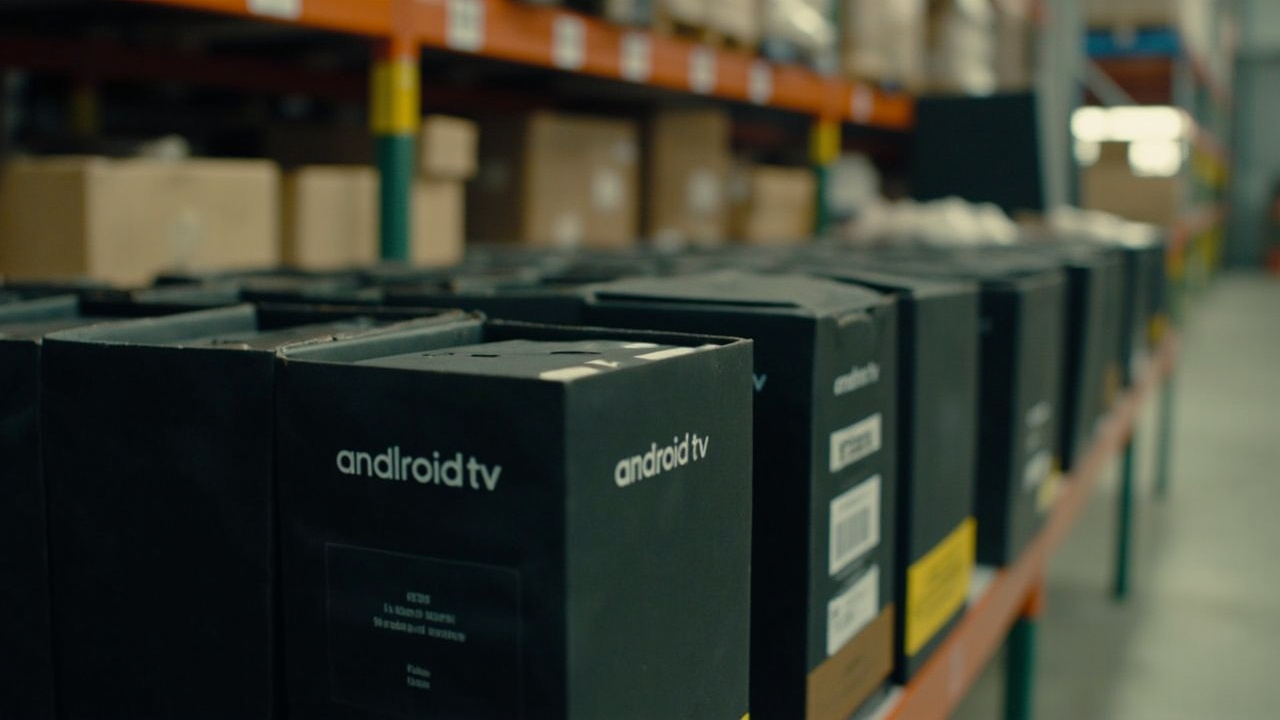
The operational lesson is simple: identify the service and playback path before selecting silicon. DRM names identify protection ecosystems; they do not certify a complete deployment. A second android tv box comparison should therefore compare acceptance responsibilities, not just model specifications.
The selection sequence that removes rework
Use a staged RFQ sequence so a FairPlay assumption, an optional DRM item or an operator middleware dependency is resolved before model approval. Each step should leave a named artifact: requirement record, model shortlist, golden-sample report and production configuration schedule. This sequence reduces rework because a rejected requirement returns to a written decision gate rather than an informal sample report.
- Define the content service Record whether the service is IPTV, OTT, cloud gaming or signage; identify the application, account model, DRM ecosystem, codec profile and output requirements. State “FairPlay required” only when an authoritative service requirement supports it.
- Freeze the protection profile Specify Widevine security level, PlayReady requirement, HDCP version where relevant, codec and resolution constraints, plus the required licence and entitlement flow. For FairPlay, require the Apple-platform playback and application path rather than inferring support from an Android TV box.
- Select the platform direction Use DM21P for the stated operator middleware fit, DM21S for the supplied IPTV/OTT white-label fit, DM21T for the supplied premium UHD and cloud-gaming fit, or DM22Q for the supplied gaming-oriented fit.
- Lock build options Put RAM, ROM, Ethernet speed, HDCP option and other production choices in writing. “Optional” means a selectable option, not a standard build.
- Validate the golden sample Test the specified application, account, licence, codec, display, network and output-protection path. Record firmware, hardware revision and application version with the result.
- Gate the pilot Use a representative unit count and a defined observation period across controlled network and display conditions. Define pass/fail criteria before the pilot begins.
- Freeze production evidence Require the accepted configuration, firmware baseline, test record and change-control process to travel with the production order and shipment records.
The first RFQ message should contain the service type, target application, required DRM ecosystem, Widevine security level if specified, PlayReady requirement, codec/resolution target, display output and protection requirements, Ethernet or Wi-Fi configuration, required memory, expected Android version, operator middleware needs, and the pilot or shipment schedule. The RFQ contact can carry that structured requirement set for evaluation. A worked example would identify multicast IPTV, Widevine L1, PlayReady, AV1 [email protected], H.265 4K@60, HDCP 2.2, RJ45 100M and a specified HDMI display profile.
Do not paste “support all DRM” as an acceptance line. It lacks a testable definition and can conceal incompatibility between the app, licence server, device security level and output path. It also encourages a supplier to substitute a broader feature list for a working playback result. Replace it with named ecosystems, versions, devices, accounts, content profiles and expected results.
The order should separate three baselines: hardware configuration, firmware configuration and content-service configuration. A change to one may require another change to be revalidated. This is particularly relevant when “optional” DRM or HDCP support appears in a quotation. The sequence turns a generic android tv box comparison into a traceable configuration record with explicit acceptance gates.
Where quotations quietly diverge
Most divergence occurs at the interface between a plausible feature claim and a reproducible acceptance test. The wording can look equivalent while describing materially different obligations. A quotation should identify whether the claim applies to the hardware platform, the production firmware, a particular ROM, one application or the complete service workflow.
Field trap
A quotation saying “PlayReady supported” does not establish that the delivered build passes the operator’s licence, app, codec and display test. Require the model, hardware revision, firmware, application and service entitlement used in the evidence. Accepting only the DRM name can move the failure from procurement into deployment.
Field trap
“FairPlay” and “PlayReady” are not interchangeable labels. Do not price or schedule a FairPlay-dependent program on the assumption that a Widevine L1 / PlayReady Android TV model also satisfies an Apple FairPlay workflow. The supplied DataMax facts list neither FairPlay nor FairPlay-certified platforms, so the required service path must be confirmed independently.
Optional wording creates another divergence. “Widevine L1 / PlayReady optional” can mean the supplier can quote the relevant build, not that every unit carries it. A quotation may omit HDCP 2.2 even though DM21P supports that option, while listing PlayReady as if the whole bundle were standard. Convert each option into a numbered line with “required,” “not required” or “pending service approval.”
Codec claims can drift from the actual service configuration. A hardware decoder list says what the platform is described to support; it does not prove that the installed application enables the correct profile, that the source carries it, or that the display path can render it. For 4K@120 programs on DM21T, the RFQ must identify the source profile, application behavior, display mode and test duration. The supplied datasheet caps its listed output and decode capabilities at 4K, so no 8K output claim belongs in the acceptance document.
Memory wording can also conceal two variables. “4GB / 64GB” may identify the configuration, but “family options” can leave room to vary it. Specify both values and whether the ROM is fixed, and require the production schedule to state them. RAM and ROM affect application behavior only in the deployed configuration, so a sample built with one profile is not evidence for every family variant.
Network options need separate acceptance. RJ45 100M and RJ45 100M with 1G optional are not equivalent for every operator workflow. The throughput requirement should be derived from the service’s video, control and update behavior, then tested on the selected configuration. Wi-Fi6 2x2 and Wi-Fi6 also require different acceptance language because the latter does not state a spatial configuration in the supplied facts.
Finally, display protection and DRM are separate controls. Widevine or PlayReady governs protected-content handling in its defined environment; HDCP governs an applicable protected output path. Requiring both names without specifying versions and test conditions leaves the output requirement open to interpretation. This is where another android tv box comparison can fail if display behavior is omitted from the acceptance sheet.
Questions to put in the supplier review
The supplier review should request evidence from the manufacturing process rather than only a feature declaration. DataMax presents manufacturing, quality and compliance controls through its manufacturing and compliance resources; the purchase order should identify which evidence is mandatory for the selected model. The objective is traceability from the accepted sample to the delivered lot, not a general statement that the factory operates an inspection line.
- Assembly evidence Ask how SMT and AOI results are linked to the work order, board or assembly identifier, and defect disposition. The supplier should show which inspection steps are automated, their sampling rules and the route for exceptions.
- Component and configuration evidence Request the controlled bill of materials or configuration record for the ordered RAM, ROM, Ethernet option, DRM build and other production choices. Confirm that substitutions require approval and revalidation.
- Aging evidence Ask for the aging method, duration, environmental conditions, sample coverage and pass criteria. Confirm what happens when a unit fails after burn-in and how the failed unit is segregated from the accepted lot.
- Dark-room evidence Request the screen or display defect procedure, including detection method, allowed limits, retest count and traceability to the finished unit.
- Audit evidence Review the internal audit scope, nonconformity process and corrective-action loop. A statement that the factory is “audited” does not identify the standard, scope, date or finding status; confirm those against the production datasheet or audit documentation.
- Firmware and DRM evidence Require the production firmware identifier, signing method, update policy and proof of the requested Widevine L1 or PlayReady configuration on representative units.
- Shipment traceability Ask how hardware revision, firmware, test result and customer configuration stay linked from factory output to shipment. Define the document or serial record that a buyer will receive.
Evidence packet for the RFQ: request the ordered model and hardware revision; RAM and ROM; OS and firmware baseline; selected Ethernet option; HDCP or other optional-feature status; Widevine security level; PlayReady test report; codec playback record; factory test summary; and the approved golden-sample and pilot results. Ask the supplier to mark any item that is not yet available rather than substituting a generic catalog claim.
Change control is part of the review, not an administrative footnote. An SoC or memory substitution can alter firmware behavior; a DRM component or firmware update can alter secure playback; and a connector or Ethernet change can affect deployment. Require advance notice, buyer approval where material, and a defined retest scope. Identify whether the customer, DataMax or the application operator owns each approval step.
The sample order should be treated as the configuration-definition tool. Specify the exact build and application before the sample arrives. Once accepted, attach its evidence to the purchase order as the golden-sample reference. A sample report should record the display model and connection, network type, test content, account class, licence outcome and whether protected output was accepted.
For AOSP-specific implications, the AOSP versus Google Android TV guide helps separate operating-system baseline decisions from application, certification and service obligations. The android tv box comparison then gains a clear boundary: manufacturing evidence validates the unit, while service validation establishes whether protected playback works.
The comparison buyers actually make
Buyers usually compare an entry configuration with a higher-commitment configuration. The meaningful difference is not a decorative performance tier; it is the number of media, connectivity and fleet variables that must be validated. The DataMax facts permit the following option-level comparison. The table also makes clear that “PlayReady” is not the only differentiator among the four models.
| Decision dimension | Entry direction: DM21P | Newer-AOSP direction: DM21S | Commitment direction: DM21T | Gaming direction: DM22Q |
|---|---|---|---|---|
| Stated fit | 4K IPTV / operator middleware set-top box | 4K Android TV box for IPTV/OTT white-label | Premium UHD / cloud-gaming box | Gaming-oriented Android TV box |
| SoC | Amlogic S905Y4, quad Cortex-A35 | Amlogic S905Y5, quad Cortex-A55 | Amlogic S905X5, quad Cortex-A510 (ARMv9) | Amlogic S905X5M, quad Cortex-A55 up to 2.5GHz |
| OS | AOSP Android 11 | AOSP Android 14 | AOSP Android 14 | AOSP Android 14 |
| Primary RAM / ROM | 2GB / 8GB | 2GB / 16GB | 4GB / 64GB | 4GB / 64GB |
| Listed DRM | Widevine L1 / PlayReady / HDCP 2.2 optional | Widevine L1 / PlayReady optional; Dolby Vision/DTS | Widevine L1 / PlayReady optional | Widevine L1 / PlayReady optional; Dolby Vision/DTS |
| Decode emphasis | AV1 [email protected]; VP9/H.265 4K@60; H.264 4K@30 | AV1 / H.265 [email protected] 4K@60 | H.266/VVC [email protected] 4K@120; AV1/VP9/H.265 4K@120; AVS3 4K@120; H.264 4K@60; inline AI-SR | AV1/H.265 L5.1 4K@60; inline AI-SR |
| Data connectivity | RJ45 100M; Wi-Fi6 2x2 + BT5.4 | RJ45 100M, 1G optional; Wi-Fi6 2x2 + BT5.4 | RJ45 100M, 1G optional; Wi-Fi6 + BT5.4 | RJ45 100M, 1G optional; Wi-Fi6 2x2 + BT5.4 |
DM21P is the leanest stated operator set-top-box path: 2GB / 8GB, AOSP Android 11 and RJ45 100M. That can reduce configuration breadth for a controlled middleware deployment, provided the application and security path are accepted on that baseline. Its listed AV1 [email protected], VP9/H.265 4K@60 and H.264 4K@30 decode set gives the buyer several service-format paths without selecting the 4K@120 commitment.
DM21S is the natural option when AOSP Android 14 and 2GB / 16GB are more useful than the DM21P’s stated baseline. The selection is not automatically “newer is better”: Android 14 adds platform baseline change and requires application, firmware and middleware validation against the target image. The 1G Ethernet option can be relevant for an OTT white-label program with larger manifests or update traffic, but it remains an option until written into the order.
DM21T changes the media commitment through the listed 4K@120 decode set and USB3.0 interface. Its 4GB / 64GB family configuration provides more headroom for the stated premium UHD and cloud-gaming fit, but the buyer still must define which 4K120 mode, source profile and protected service will be accepted. The 100M Ethernet base and 1G option should be reconciled with the service model rather than selected by preference. No HDMI input is listed, so the RFQ should not presume a source-capture path.
DM22Q shares AOSP Android 14 and a 4GB / 64GB family baseline with DM21T but presents a different stated fit. It lists AV1/H.265 L5.1 4K@60, dual USB2.0 ports, Wi-Fi6 2x2 and optional 1G Ethernet. Gaming evaluation must add input, service, latency and stability criteria, none of which is quantified in the supplied facts. Its “up to 2.5GHz” CPU statement is a clock description, not an acceptance metric for game performance.
For editorial visualization, these control options can be ranked qualitatively as follows. The scale is a planning aid, not a measurement or audited performance score.
The practical choice is between platform complexity and proof depth. A simpler model still needs service-level validation; a more capable model still needs a defined acceptance test. Neither substitutes for the other. In this android tv box comparison, procurement maturity should be measured by the completeness of the evidence chain rather than by the number of features printed on a datasheet.
Where the terminology comes from
DRM is a content-protection system with several linked parts: encryption, licence issuance, device or platform security, playback rules, output protection and service entitlement. The device is only one participant. A successful demonstration therefore requires the app, device security level, licence service, account entitlement, source content, decoder, display and network to behave as one system.
Widevine is Google’s DRM ecosystem for protected media delivery. Google’s Widevine DRM Architecture Overview defines Security Level 1: all content processing, cryptography and control performed within the TEE and Security Level 3: no TEE on the device; protection in the host OS; a hardware crypto engine improves performance only, not security.
Source: Google / Widevine, Widevine DRM Architecture Overview
That definition explains why “Widevine L1” belongs in an RFQ and why the device architecture matters. Level 1 is not a synonym for every Android box that can show a protected stream. The production device, firmware, security integration and application path must support the required level. A firmware replacement that changes the security architecture should therefore trigger a new service-level test.
PlayReady is a separate DRM ecosystem. A device can support Widevine and PlayReady while not supporting FairPlay. Conversely, a FairPlay-oriented service generally requires its designated application, playback environment, account rules and device integration. The ecosystem names identify distinct control paths; they do not form a maturity ladder in which one can be assumed from another. FairPlay support must be established by an authoritative service requirement and a reproducible playback result, not inferred from Android hardware compatibility.
HDCP is a separate output-protection mechanism. Its relevance depends on the content service, display path and device configuration. A DRM can be correctly implemented while a downstream display or cable path prevents intended protected output. For that reason, HDCP should be specified by version and tested rather than inferred from a decoder claim. The DM21P’s optional HDCP 2.2 line should consequently identify whether the option is fitted and whether it satisfies the service’s output policy.
AV1, VP9, H.265/HEVC, H.264 and H.266/VVC are media codecs, not DRM systems. Codec support governs decoding efficiency and format compatibility; DRM governs access to protected content. A platform may decode a codec but still fail to obtain a licence, or obtain a licence but lack the required codec profile for the service. A FairPlay requirement can likewise originate in application distribution rather than the codec list.
Source: Google / Widevine, Widevine DRM Architecture Overview
The architecture behind an acceptance record should therefore contain six fields: device model and hardware revision, firmware build, application version, DRM ecosystem and security level, content and codec profile, and display/network conditions. Add the licence-service and entitlement result, because success without that result may only prove local decoding. This record also prevents the android tv box comparison from collapsing different stages of the chain into one feature label.
AOSP is the open-source Android platform baseline used in the supplied DataMax specifications. It is separate from the Google Android TV certification and application-distribution framework. A product may therefore use an AOSP image and still implement operator middleware, an integrated app, remote management or update services through additional engineering. The AOSP and Google Android TV guide helps identify which ecosystem decisions belong in the platform RFQ.
The final procurement distinction is capability versus entitlement. A model can support a DRM technically, but a service operator can still restrict devices, accounts, resolvers, applications or output modes. Conversely, an application can present a valid licence but fail because the chosen device build does not meet the service’s security policy. The evidence must therefore travel from the supplier to the application team and the service operator, with a named result for each layer.
Further reading
- Android TV Box For Sale: Catalogue Versus Commissioned
- 4K 60fps Android TV box guide
- Rockchip Android TV box guide
- Dolby Vision Android TV box guide
- RFQ checklist for device procurement
- DataMax DM21P specifications and fit
- DataMax DM21S specifications and fit
FAQ
Does Widevine L1 make an Android TV box equivalent to FairPlay?
No. Widevine L1 describes the protection architecture used for Widevine content, while FairPlay belongs to a separate Apple-centric streaming ecosystem. The supplied DataMax models list Widevine L1 and PlayReady, but not FairPlay. A FairPlay-dependent service requires its own application, device, entitlement and playback validation.
Is PlayReady sufficient for a commercial IPTV deployment?
Not by itself. The RFQ should also define the application, operator middleware, Widevine security level, codec profile, HDCP requirement, licence flow, output path and account policy. A PlayReady feature claim becomes usable only after the complete playback chain passes on the exact production build.
Which DataMax model best fits an operator middleware set-top box?
The supplied facts identify DM21P specifically as the fit for a 4K IPTV / operator middleware set-top box. It uses an Amlogic S905Y4, AOSP Android 11, and a 2GB / 8GB baseline, with Widevine L1, PlayReady and optional HDCP 2.2. The final configuration still requires golden-sample validation.
Should DM21S replace DM21P simply because it has Android 14?
Not automatically. DM21S provides a different stated baseline: Amlogic S905Y5, AOSP Android 14 and 2GB / 16GB, with optional 1G Ethernet. Moving to Android 14 can add application, middleware and firmware validation. Select it when its network, memory and platform benefits offset that validation work.
What evidence should accompany a production order?
Request the accepted model and hardware revision, RAM and ROM, Ethernet option, OS and firmware identifiers, optional-feature status, Widevine and PlayReady test evidence, factory inspection records, golden-sample results and the pilot report. These should be linked to the production configuration and shipment traceability records.
Does 4K@120 decode support guarantee a 4K@120 service?
No. The supplied DM21T facts list H.266/VVC [email protected], AV1, VP9, H.265 and AVS3 at 4K@120. The delivered service must provide a compatible source profile, the application must request the intended output mode, and the display must support the resulting signal. Validate the complete path rather than accepting the decoder list alone.




