The short answer first
| Decision axis | RK3566 direction | Procurement consequence |
|---|---|---|
| Compute platform | Rockchip RK3566 with quad Cortex-A55 | Use for fanless cellular 4K distribution or signage workloads where operator middleware is not the primary constraint. |
| Memory | 4GB / 32GB base configuration | Fix RAM and storage line-by-line in the purchase order; higher tiers are options rather than assumptions. |
| Media | H.265/H.264/VP9 4K@60 decode; 1080P@60 encode | Validate the complete playback chain, including output mode, source format, HDR policy and signage workload. |
| Connectivity | SIM x1 for 5G/4G LTE, RJ45 100M, Wi-Fi6 and BT5.2 | Confirm modem, antenna and carrier approval because “cellular” does not define every deployment requirement. |
| Commercial role | Selected platform, not a generic chip specification | Compare against the broader category represented by Android TV box: what it is and what it is not. |
For an android tv box procurement, RK3566 is credible when the product is a fanless cellular 4K box or a signage player rather than a fixed operator set-top box with tightly controlled DRM obligations. The DataMax DM35R combines RK3566, a quad Cortex-A55 CPU, 4GB RAM, 32GB storage, AOSP Android 13 and cellular connectivity. Its lifecycle question is therefore not “Can RK3566 decode 4K?” but “Can the supplier freeze a precise configuration and support it consistently across production, firmware, recovery and replenishment?”
The answer also depends on what “performance” means. Codec capability, memory capacity, thermal behaviour, operator integration, licensed DRM and update control are separate axes. A chip comparison cannot replace a production datasheet, RFQ line or factory evidence. For operators requiring Widevine L1, PlayReady, HDCP 2.2 or an Android TV-oriented product programme, review the Amlogic alternatives rather than inferring DRM support from the RK3566 platform. Confirm every configuration against the production datasheet and the approved golden sample.
A practical RK3566 buy therefore has four gates. First, the SoC must support the required media path. Second, the delivered RAM, storage, interfaces and radio must be frozen. Third, the operator or signage software must run on the approved image. Fourth, the supplier must demonstrate traceability from the purchase order to the shipped serial-number range. Passing only the first gate produces an attractive specification sheet but an unreliable programme. A cellular signage order, for example, may not need DRM, yet it still needs a defined modem, band plan, thermal limit, reboot policy and recovery procedure. The canonical Android TV box: what it is and what it is not explains the broader category distinction; this comparison focuses on the RK3566 decision and its lifecycle consequences.
The platform shortlist with datasheet values
| Model | SoC and CPU | OS | RAM / storage | Fit and key interfaces |
|---|---|---|---|---|
| DM35R | Rockchip RK3566, quad Cortex-A55 | AOSP Android 13 | 4GB / 32GB; 2/4/8GB RAM and 16/32/64GB storage optional | Fanless cellular 4K box / signage player; HDMI 2.0b out, USB2.0 x2, TF, SIM x1 for 5G/4G LTE, RJ45 100M with 1G optional, Wi-Fi6, BT5.2, DC5V/2A |
| DM21P | Amlogic S905Y4, quad Cortex-A35 | AOSP Android 11 | 2GB / 8GB; 4GB RAM and 16/32/64GB storage optional | 4K IPTV / operator middleware set-top box; HDMI 2.0b out x1, USB2.0 x2, TF, S/PDIF, 3.5mm AV, RJ45 100M, Wi-Fi6 2x2, BT5.4, DC 5V/2A |
| DM21S | Amlogic S905Y5, quad Cortex-A55 | AOSP Android 14 | 2GB / 16GB; 2/4/8GB RAM and 16/32/64GB storage optional | 4K white-label IPTV/OTT platform; HDMI 2.0b out, S/PDIF, AV, USB2.0 x2, TF, RJ45 100M with 1G optional, Wi-Fi6 2x2, BT5.4 |
| DM21T | Amlogic S905X5, quad Cortex-A510, ARMv9 | AOSP Android 14 | 4GB / 64GB; family options | Premium UHD / cloud-gaming box; HDMI 2.0b out, no HDMI in, USB2.0 x1, USB3.0 x1, TF, S/PDIF, AV, RJ45 100M with 1G optional, Wi-Fi6, BT5.4 |
The shortlist separates four distinct product positions. DM35R is the RK3566 choice in the DataMax range, while DM21P prioritizes operator middleware, DM21S addresses white-label IPTV/OTT programmes, and DM21T targets premium UHD or cloud-gaming use cases. The chipset, OS generation and media pipeline differ materially, so they are not interchangeable drop-in alternatives.
DM35R also lists an 8M ISP and 1080P@60 encode capability in addition to H.265/H.264/VP9 4K@60 decode. DM21P adds AV1 Main Profile 10 Level 5.1, VP9 and H.265 4K@60, plus H.264 4K@30. DM21S lists AV1 and H.265 Main Profile 10 Level 5.1 at 4K@60. DM21T lists H.266/VVC Main10 Level 5.2, AV1, VP9, H.265 and AVS3 at 4K@120, H.264 at 4K@60, and inline AI-SR. These are platform capabilities, not proof that every commercial unit includes an active licence, the specified output configuration or a particular operator middleware build.
DRM declarations require equal precision. DM35R states no DRM. DM21P and DM21S list Widevine L1 and PlayReady as optional, with HDCP 2.2 also optional on DM21P. DM21S additionally lists Dolby Vision and DTS. DM21T lists Widevine L1 and PlayReady as optional. “Optional” belongs in the quotation and purchase order, not in an inferred certification claim. Use the AOSP versus Google Android TV guide to clarify the OS distinction before comparing platform labels.
The comparison also separates output from decode. DM21T lists a higher-frame-rate media capability, but HDMI 2.0b output and no HDMI input. A source at 4K@120 therefore requires a compatible endpoint and an explicitly approved output mode. Likewise, the absence of HDMI input on DM21T prevents a simple pass-through topology unless another signal path is specified. These constraints belong in the RFQ before a sample is ordered, because changing them after mechanical and firmware work begins affects tooling, validation and schedule.
Storage selection should follow the application’s write and recovery pattern. Signage with local media can prioritize usable storage and deterministic playback; operator middleware may need headroom for application data, diagnostic logs and staged updates; cloud gaming may place greater demand on latency and input-response behaviour. The listed configurations support these different starting points, but they do not define endurance, partitioning or update retention. Ask the supplier for the exact partition layout, recovery method and minimum usable storage for the quoted image.
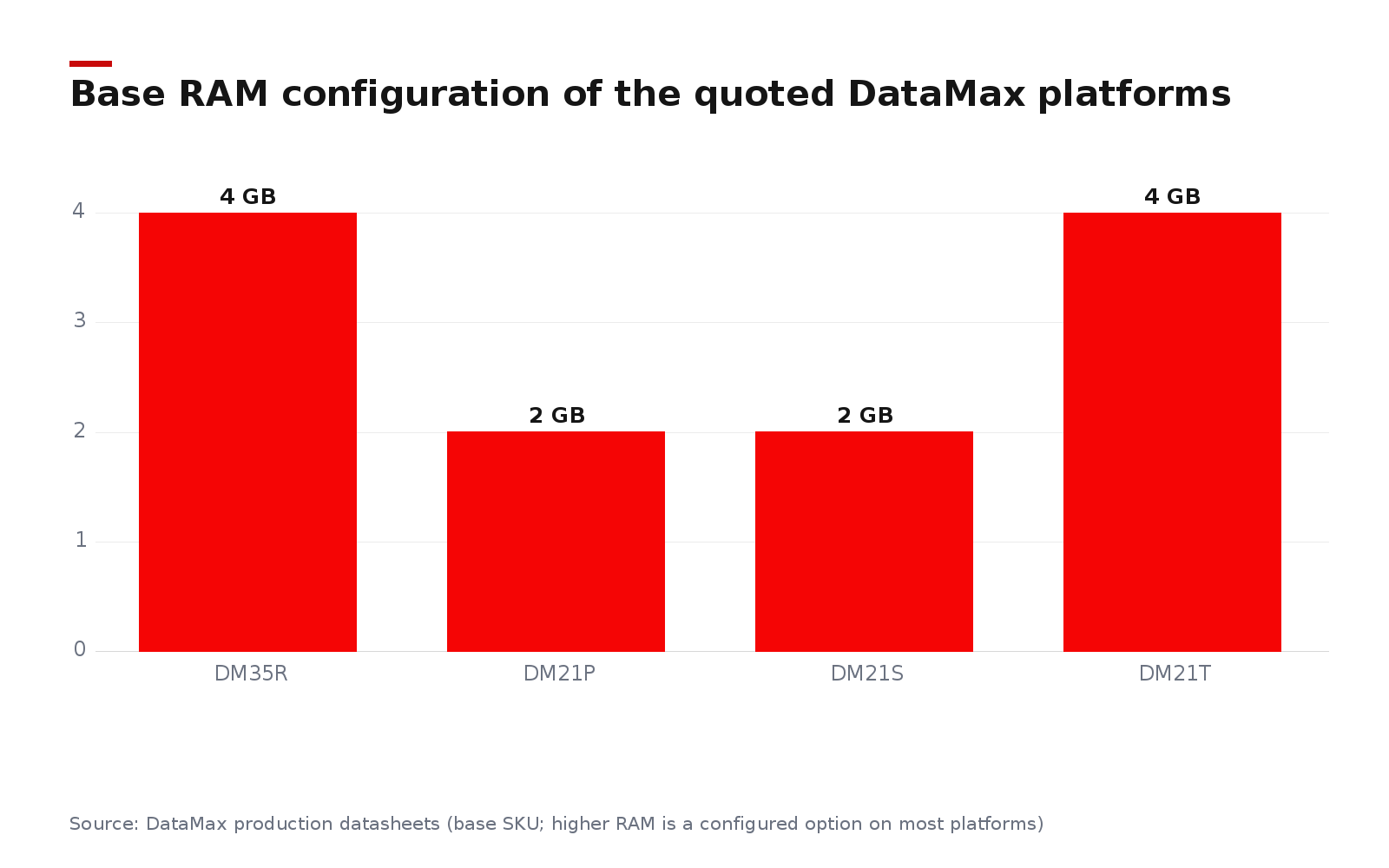
The same figures, in searchable form:
| Platform | Base RAM |
|---|---|
| DM35R | 4 GB |
| DM21P | 2 GB |
| DM21S | 2 GB |
| DM21T | 4 GB |
Source: DataMax production datasheets. Base configuration only; optional RAM tiers exist and must be fixed line-by-line in the PO.
A procurement sheet should reproduce these values without silently converting “family options” into a universal memory commitment. For DM21T, the quoted base is 4GB / 64GB; any alternative family configuration must be named in the PO. For DM35R, 4GB / 32GB is the base, while 2/4/8GB RAM and 16/32/64GB storage are options. This prevents a 2GB development sample from silently becoming the 4GB production benchmark. Configuration approval should occur after the firmware image, application build and accessory list are fixed, because memory and storage changes can alter image size, boot behaviour and test coverage.
How the requirement actually works
An RK3566 programme has four architectural layers: silicon capability, Android software integration, product hardware and lifecycle governance. Silicon capability answers what the SoC can decode or encode. It does not determine the installed OS image, licensed content path, sustained thermal performance or field-update policy. These layers must be evaluated separately.
The DM35R uses a quad Cortex-A55 arrangement on Rockchip RK3566. The listed media pipeline supports H.265, H.264 and VP9 4K@60 decode, 1080P@60 encode and an 8M ISP. In a live operator programme, however, the practical test is the full path: media ingestion, middleware playback, DRM where applicable, output timing, network buffering, storage writes and sustained operation. A codec header alone does not establish that path.
AOSP Android 13 is also not synonymous with Google Android TV certification. AOSP describes the software base, while Android TV device qualification, Widevine certification, operator middleware and regional regulatory obligations are separate programmes. The AOSP versus Google Android TV guide helps establish that distinction. For this DataMax platform, no DRM is stated, making the DM35R unsuitable as an assumed substitute for a DRM-dependent pay-TV deployment.
Connectivity is equally layered. The DM35R specification includes a SIM slot for 5G/4G LTE, RJ45 100M with an optional 1G configuration, Wi-Fi6 and BT5.2. A cellular programme must still define the modem, supported bands, regional approvals, antenna path, SIM form factor, carrier provisioning and thermal enclosure. The existence of a SIM slot does not close those engineering questions.
Lifecycle means more than the age of RK3566. It includes binary availability, BSP maintenance, device tree changes, Android security patching, recovery images, bootloader behaviour, component alternation and the supplier’s ability to reproduce an approved unit. The platform becomes dependable only when the BOM, image version and test evidence are tied to an identifiable production revision.
The final node is the procurement control point. It should identify the production hardware revision, OS build, software components, approved accessories and acceptance tests. Without that record, a nominal SoC comparison cannot support replenishment decisions.
Performance testing should mirror the production load rather than isolate the decoder. For DM35R, a useful test combines the target 4K media profile, the intended signage application or operator software, the selected Ethernet or cellular path, and the final display mode. Record frame presentation, audio output, reboot recovery and network reconnection. If the device also records or encodes at 1080P@60, test that path with its storage and thermal burden rather than treating it as an unused headline capability.
The ISP specification matters to image acquisition, not merely to playback. A camera-oriented deployment must state resolution, frame rate, exposure and application requirements because the listed 8M ISP does not specify an entire imaging pipeline. A signage-only programme may not need that path at all. This is another reason to separate mandatory requirements from catalogue capabilities before allocation is frozen.
Lifecycle governance also covers failure recovery. A production unit should have a defined recovery path if an update fails, storage becomes unavailable or the image is corrupted. The buyer needs to know whether recovery is local, requires a host tool, requires a connected service or depends on a partition layout that has already been approved. The platform’s AOSP Android 13 label is the starting point; it does not document the recovery implementation by itself.
Two routes, one bill of differences
The practical choice is between a cellular or signage-oriented RK3566 route and an operator-oriented Amlogic route. The bill of differences is not simply “Rockchip versus Amlogic.” It includes the required feature set, licensed-content obligations, output path, installed software, storage tier, network architecture and the evidence required at acceptance.
| Dimension | DM35R / RK3566 route | Operator and white-label Amlogic route |
|---|---|---|
| Primary fit | Fanless cellular 4K box / signage player | DM21P for IPTV and operator middleware; DM21S for white-label IPTV/OTT; DM21T for premium UHD or cloud gaming |
| Compute | Rockchip RK3566, quad Cortex-A55 | S905Y4 with quad Cortex-A35, S905Y5 with quad Cortex-A55, or S905X5 with quad Cortex-A510 |
| Software baseline | AOSP Android 13 | AOSP Android 11 on DM21P; AOSP Android 14 on DM21S and DM21T |
| DRM position | No DRM stated | Widevine L1 and PlayReady optional across the listed models; HDCP 2.2 optional on DM21P |
| Connectivity distinction | SIM x1 for 5G/4G LTE is part of the listed platform | RJ45 100M, with 1G optional on DM21S and DM21T; no cellular provision is stated |
| Commercial commitment | Best justified by cellular use or signage requirements | Best justified by operator software, codec profile or licensed-content requirements |
The RK3566 route is the entry into cellular distribution for an android tv box programme when field connectivity, fanless construction and signage playback matter more than a stated DRM service. The operator route carries a larger platform commitment because middleware, codec licensing and Android image integration become part of the acceptance equation.
Do not convert the editorial scale into a benchmark. The procurement decision must use the quoted configuration and an approved sample. A cellular build can still fail if the operator image, modem or regulatory evidence is incomplete. Likewise, an Amlogic platform with optional DRM becomes suitable only after the relevant licence and option are fixed and verified.
The “one bill of differences” should therefore contain the chipset, OS build, RAM and storage, codec obligations, output specification, interfaces, connectivity, middleware, accessories, packaging, firmware ownership, certification evidence and replenishment rule. Anything left as “equivalent” becomes a negotiation risk.
The route also changes where the buyer’s engineering effort goes. A DM35R signage programme may spend most effort on enclosure thermals, scheduler behaviour, local media management and cellular resilience. An operator programme on DM21P or DM21S may spend more effort on middleware interfaces, conditional access, licence provisioning, broadcast or OTT service integration and regression testing. A DM21T premium route adds endpoint and display-mode validation. These are different integration loads even when two products have the same output connector and nominal 4K label.
The commercial route should therefore compare the supplier’s configuration-control obligations, not just the initial unit specification. A cellular box needs evidence for radio and network behaviour; a licensed-content box needs evidence for DRM provisioning; a signage box needs evidence for endurance and recovery. The appropriate supplier can differ even when the application uses the generic android tv box label.
Deployment scenarios and the spec each needs
| Scenario | Primary requirement | Model direction | Must be fixed in the RFQ |
|---|---|---|---|
| Operator IPTV programme | Middleware integration, AV1 or HEVC playback, optional licensed DRM | DM21P or DM21S | Middleware version, Widevine L1 and PlayReady option, HDCP 2.2 where relevant, output and storage configuration |
| White-label OTT service | AOSP Android 14 base, codec coverage, branded installation | DM21S | 2GB / 16GB base or selected tier, Dolby Vision/DTS option if required, RJ45 100M or 1G, recovery policy |
| Cellular retail or branch distribution | LTE operation, fanless enclosure, field connectivity | DM35R | SIM x1, supported 5G/4G LTE bands, modem, antennas, RJ45 configuration, power supply and thermal test |
| Digital-signage player | Continuous local playback, scheduled reboot, remote recovery | DM35R | Storage tier, signage application, display mode, playback test and OTA mechanism |
| Premium UHD or cloud gaming | Higher-frame-rate media, ARMv9 CPU, high-speed device connectivity | DM21T | 4K@120 source and output path, USB3.0 use, 4GB / 64GB baseline, DRM options and network latency target |
For an operator, the decisive question is middleware and content-service compatibility. The operator-tier Android TV box solution provides the broader purchasing frame. For DM35R, the buyer should not ask whether an android tv box can theoretically run middleware; the RFQ should require the target middleware version, service interfaces, operator settings and the exact image to be demonstrated on production-revision hardware.
For signage, continuous playback changes the test method. A five-minute decode demonstration does not establish 72-hour stability, scheduled reboot recovery or deterministic reconnection after network loss. The acceptance test should include target media, display resolution, loop behaviour, playlist update method, local storage endurance and recovery from power interruption.
For cellular distribution, RF exposure and thermal design affect both stability and certification. The RFQ should identify supported bands, antenna connectors or an integrated antenna specification, modem platform, SIM interface, carrier acceptance status and the target regulatory markets. The published DM35R facts identify the cellular capability at platform level; they do not state every modem or band.
For premium UHD, 4K@120 support is a chain requirement. Source codec, decoder, display mode, HDMI output configuration and endpoint capability must align. The DM21T facts list H.266/VVC Main10 Level 5.2, AV1, VP9, H.265 and AVS3 at 4K@120, but a deployment still needs an exact output mode and test media definition.
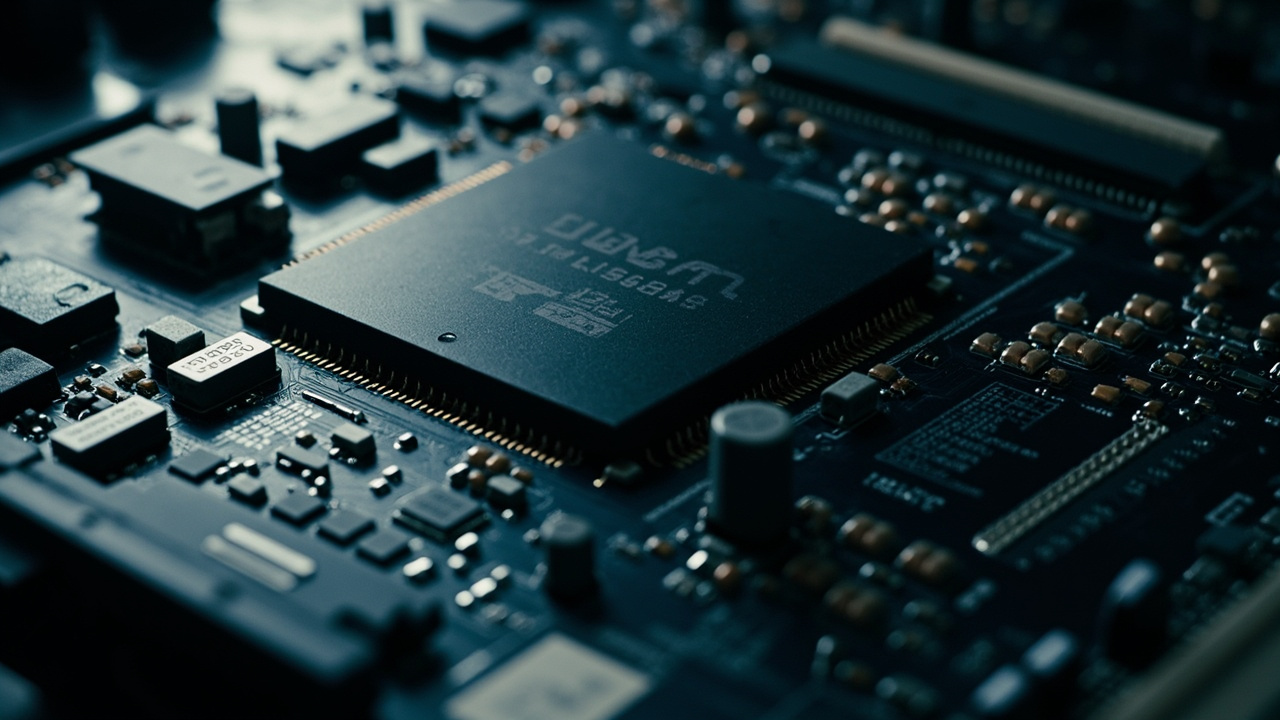
The image below illustrates the physical implementation decision: a system-on-chip package and surrounding memory on a mainboard influence heat, routing and serviceability.
An integrator deploying displays across multiple rooms should also distinguish video playback from control. The RFQ may need network discovery, remote command, device identification, scheduled restart and a recovery mechanism. None of those functions is guaranteed by HDMI 2.0b, Wi-Fi6 or the presence of RJ45. For a multi-site rollout, ask for the control protocol, remote-management dependencies and what the unit does after a network outage. Local playback continuity is often more operationally valuable than an additional codec mode.
For an operator migrating from an earlier set-top generation, validate the complete service sequence rather than the launcher alone: device activation, entitlement retrieval, channel navigation, stream startup, pause and return, channel change, service restart and recovery after reboot. Record expected results for each step and identify the responsible middleware version. This test protocol can reveal whether a platform shortlist must change before branding or packaging work begins.
What goes wrong after the PO
The most common post-order failure is not a defective decoder. It is an ambiguous configuration reaching the production line. “RK3566 Android box with 4GB” may omit storage, cellular modem, bandwidth, antenna type, OS build, regional approvals and firmware ownership. Each omission creates a different bill of materials and test protocol.
Field trap
A platform page may be updated after a quotation is issued. If the PO says only a model name, the production datasheet can change the RAM, storage, radio option or interface arrangement without changing the commercial document. Attach the approved datasheet revision and golden-sample identifier to every line.
A second trap is confusing platform DRM labels with deployed licence state. DM35R states no DRM, while the other models list Widevine L1 and PlayReady as optional. An android tv box sample may display an expected playback path while the production order omits the licence, provisioning process or protected output configuration. Put the option status, service level, device identity process and playback acceptance test into the PO.
Codec marketing creates a related risk. DM21T’s listed capabilities reach 4K@120, while its output specification is HDMI 2.0b and the datasheet caps decode/output at 4K. Do not translate that into an 8K claim. Likewise, do not infer 4K@60 playback from a generic “4K” label; specify the codec, profile, level and frame rate.
Thermal and power failures appear later because a short bench test does not reproduce the installed enclosure, cellular radio load or ambient condition. For a fanless product, specify the enclosure, ambient temperature, video workload, network state and run duration. The DM35R power listing is DC5V/2A; use an approved supply and verify the assembled unit rather than relying on a component rating.
Firmware drift causes another post-PO problem. If the build identifier is absent, “latest image” can shift the launcher, middleware, codec behaviour, recovery partition and security patch level. Name the image version, approval date and update responsibility. A production unit without an authenticated, recoverable image is not a complete deliverable.
Finally, cellular hardware creates regulatory and logistics variation. Modem, bands, approvals and carrier acceptance must match the target market. A generic SIM slot in the datasheet is not evidence of nationwide or operator-specific approval. Keep the market scope, test evidence and antenna configuration attached to the order.
A related failure occurs when the sample is not representative of the production line. A hand-built evaluation board may expose more memory, a different module or a different image than the shipping assembly. The result can be a successful sample that fails when loaded with the operator build. Require the golden sample and the production unit to share the same hardware revision, RAM and storage tier, radio option, firmware build, recovery mechanism and approved accessories. If a development configuration is necessary, label it clearly and prohibit its use as the acceptance baseline.
The commercial consequence of ambiguity is often larger than the component difference itself. A missing Ethernet option can change the PCB and test procedure; a missing modem can delay regulatory work; an undefined image can cause a full application regression. Require the supplier to state which changes require re-approval, which are administrative and which trigger a new sample. A change-control matrix attached to the PO reduces disputes over a 1G Ethernet option, an alternative storage tier or a revised Android build.
How to choose, step by step
- Classify the deployment Write down whether the product is an operator set-top box, white-label OTT device, cellular distribution unit, signage player or premium UHD/cloud-gaming box. Reject comparisons that mix these roles.
- Fix the non-negotiable service requirements State OS family, middleware, codec profile, DRM, output mode, connectivity, storage endurance and recovery. A chipset cannot waive an application-level requirement.
- Create the shortlist Use DM35R when cellular or signage fit is decisive. Use DM21P for operator middleware, DM21S for AOSP Android 14 white-label deployment, and DM21T for the listed 4K@120 premium capability.
- Freeze the production configuration Write RAM, storage, interfaces, radio options, power, image version, approved accessories and packaging as separate PO lines. Confirm against the production datasheet.
- Validate on a golden sample Test the actual image, display, network, middleware and media workload. Record hardware revision, image build, test media, duration and pass criteria.
- Approve lifecycle governance Define security update responsibility, OTA or recovery method, bootloader policy, component substitution controls, production-change notice and replenishment reference.
The first RFQ message should be paste-ready: “Please quote the DataMax model, SoC, Android build, RAM and storage, output and codec requirements, DRM status, cellular or wired network options, power supply, approved accessories, test evidence and production lifecycle controls. Include a configuration-specific datasheet and sample plan.” Use the RFQ inquiry to send that package, or request evaluation units through sample ordering.
The selection record should identify why a platform was rejected as well as why it was chosen. For example: “DM35R selected for cellular distribution and fanless operation; no DRM service required. DM21S retained as an alternative where Android 14, AV1 and optional content licences are required.” That reasoning prevents a later sales substitution from changing the deployment assumption.
RFQ field trap
Do not write “equivalent” beside RAM, storage, modem, Wi-Fi, Bluetooth, Ethernet, power or codec requirements. These options affect the assembly, test time, certification path and delivered behaviour. Write the exact required value and the evidence needed to accept it.
Commercial comparison should then use the complete delivered configuration, not the lowest catalogue entry. Compare lead-time commitments, sample-to-production change control, firmware ownership, support responsibility and documented rerun rules. Any value outside the supplied DataMax facts requires written confirmation from the relevant supplier.
A practical scoring sheet can assign a mandatory gate before adding preference points. Make codec profile, licensed DRM, middleware compatibility, selected connectivity and recovery method pass/fail gates. Then score operational considerations such as thermal evidence, documentation quality, update responsibility and replenishment traceability. This prevents a strong preference for one SoC from obscuring an unmet service requirement.
For operator or OTT projects, the AV1 Android TV box guide clarifies codec decisions, while the H.265/HEVC Android TV box guide helps define media acceptance. These guides support the platform decision; they do not replace source-media testing or contractual specifications.
The final approval should contain two named references: the configuration-specific production datasheet and the golden sample. Any difference between them should be resolved before the purchase order is released. If a factory proposes an alternative component, document the reason, affected tests, revised test evidence and approval authority. This procedure turns platform selection into a repeatable procurement decision rather than a one-time benchmark comparison.
Questions to put in the supplier review
- Trace the production revision Ask for the hardware revision, BOM status, firmware build and serial-number scheme that identify each shipped unit. Confirm that the quotation, sample and production line use the same configuration.
- Review SMT and AOI evidence Request inspection coverage, defect definitions, placement records and the disposition process for components not listed on the approved BOM. The evidence should connect inspection results to the production lot.
- Review aging and dark-room evidence Require defined burn-in or aging conditions, the loads applied, sample coverage, failure criteria and corrective-action records. Confirm that the unit is assembled in its intended configuration.
- Audit the image trail Match the binary checksum, build identifier, bootloader version, configuration, partition layout and recovery procedure to the approved sample.
- Validate the finished system Run functional, media, network, input/output and recovery tests on the production-revision device. Record the test media and endpoint configuration rather than accepting a generic codec demonstration.
- Control changes Establish advance notice for SoC, memory, storage, radio, power, display, mechanical or Android changes, plus the method for validating a new production run.
Evidence rule: each release file should connect the PO line, BOM revision, firmware build, test report and delivered serial-number range. A test report without a traceable configuration is context, not acceptance evidence.
The review should also address security and field operations. Ask whether updates are signed, whether failed updates recover, whether the system supports secure boot, how device identity is provisioned and what happens when a regional firmware variant is replaced. For the cellular variant, include modem firmware, network registration and antenna test evidence in the review.
The factory quality programme provides the appropriate context for incoming inspection, process control and traceability. Compliance documents should be checked through the certifications and compliance resources, with the exact target market stated in the RFQ. A generic compliance statement is not evidence for a specific cellular, radio or market variant.
For custom software, operator middleware or a tailored image, scope the ownership boundary through custom development. Record source-code or binary ownership, update responsibility, test cases and the production image identifier. A hardware quotation that does not name the software baseline leaves the largest lifecycle variable undefined.
Ask the supplier to explain how a failed unit is quarantined and traced. The corrective-action record should identify the failed serial number, symptom, hardware revision, image build and disposition, then connect the correction to subsequent inspection or test records. This closes the loop between field failure and production control. Without that path, the buyer may receive the same corrective action twice through different channels without knowing whether the affected lot was contained.
For ongoing replenishment, request a configuration continuity statement. It should identify which BOM, image, boot artefact, recovery image, accessory and packaging references remain valid for the next production run. Also define the notice period and approval right for substitutions. A replenishment order should not silently become a new qualification programme, but it must not conceal changes either.
Further reading
- Android TV Box: What It Is and What It Is Not
- Rockchip Android TV boxes
- Edge computing boxes
- 4K 60fps Android TV box guide
- Rockchip Android TV box guide
- DataMax DM35R specifications and fit
- DataMax DM21P specifications and fit
FAQ
Is RK3566 sufficient for a 4K Android TV box?
RK3566 with a quad Cortex-A55 supports the stated DM35R media profile, including H.265, H.264 and VP9 4K@60 decode and 1080P@60 encode. Suitability still depends on the Android image, middleware, thermal design, sustained workload and output configuration. Validate the production configuration rather than relying on the SoC name alone.
Does the DataMax DM35R support Widevine L1 or HDCP 2.2?
No DRM is stated for DM35R. Do not assume Widevine L1, PlayReady or HDCP 2.2 support from its RK3566 platform or 4K decoding capability. If a deployment requires licensed content protection, review DM21P, DM21S or DM21T and confirm the applicable optional DRM in the quotation.
Which DataMax model is better for cellular distribution?
DM35R is the listed cellular direction because it includes a SIM slot for 5G/4G LTE and is positioned as a fanless cellular 4K box. Its modem, supported bands, antennas, approvals and carrier requirements still require confirmation against the production datasheet and the target market.
Can DM21T support 8K output?
No 8K claim should be made from the supplied facts. DM21T lists HDMI 2.0b output and a maximum decode/output profile of 4K, including several formats at 4K@120. Confirm the exact source codec, display mode and output settings on a production-revision sample.
What should be fixed in an RK3566 purchase order?
Fix the model, hardware revision, SoC, RAM, storage, OS image, cellular and Ethernet options, Wi-Fi and Bluetooth version, interfaces, power, accessories, codec requirements, test evidence and replenishment configuration. “Equivalent” is inadequate because each option changes the BOM or acceptance procedure.
How should lifecycle support be documented?
Link the purchase order to the approved BOM revision, firmware build, bootloader version, test report and serial-number range. Define update ownership, recovery procedures, component-change notification, production-change approval and the evidence required for any substituted part. This creates a traceable path from sample approval to replenishment.