
The procurement answer in one screen
An RFQ lands with six model names, three memory options, and a request for “Saudi approval.” The commercial team can compare the quotation, but the compliance reviewer cannot approve a family-level statement. For telecommunications type approval, the buyer needs a traceable evidence package linking the exact production SKU, radio configuration, software baseline, supplier identity, and certificate record.
The immediate collection comprises four controlled items: the applicable type-approval certificate or authorization record; the approved-model or variant mapping; the technical evidence supporting that mapping; and the commercial record connecting the offered configuration to the manufactured item. For an Android TV box, verify DRM and content-security provisions separately. Those provisions matter to deployment, but their presence does not prove type-approval coverage.
The sample, purchase order, and shipment must remain one evidence object. A unit accepted during evaluation must be traceable to the production bill of materials and the certificate record used during tender review. That chain protects handover between sourcing, compliance, the staging warehouse, the installer, and the operator.
telecommunications type approval is therefore a collection-and-mapping task before it is a model-selection task. Request the evidence set with the RFQ, freeze the offered configuration, validate the record’s identity and scope, and preserve the registry result and checking date. For the broader support matrix and mechanism overview, use the canonical telecommunications type approval reference.
DataMax can support the production documentation and RFQ response, but certificates and DRM/security provisions are confirmed per ordered SKU, not per catalogue page. Review the compliance process and certification evidence process before freezing the bid. Retain the exact checked record, the verification date, the configuration mapping, and all approval conditions in the contract file.
Where this matters in a deployment
The collection task changes when the same Android TV box moves from an operator trial into a hotel, retail network, or cloud-gaming venue. The hardware family may remain stable while the regional sales image, middleware, DRM configuration, cabling, and ownership record change. A deployment that lacks configuration discipline can therefore pass the sample stage and fail at receiving.
| Situation | Evidence requirement | Model direction |
|---|---|---|
| Operator IPTV rollout | Certificate record linked to the offered hardware variant, firmware baseline, radio configuration, and operator middleware; deployment evidence retained. | Use an operator middleware platform, such as DM21P, then confirm the ordered configuration. |
| Retail or hospitality OTT | Approved-model mapping plus the exact regional sales image, DRM terms, update policy, and residual or white-label configuration record. | Use a white-label-oriented platform such as DM21S, subject to SKU confirmation. |
| Cloud-gaming venue | Evidence tied to the shipped SoC and memory configuration; output, codec, network, and account-security checks separated from type-approval evidence. | Use DM21T where the premium UHD workload applies; confirm production output limits in the datasheet. |
| Gaming-oriented Android TV deployment | Approved model and radio baseline reconciled with the final Android build, then checked against gaming middleware, network, and DRM requirements. | Use DM22Q, subject to configuration confirmation. |
| Distributor-managed order | One evidence chain across quotation, purchase order, production serial range, packing list, and shipment; no distributor-supplied summary in place of the source record. | Define the SKU and document ownership before sample approval. |
| Operator-managed fleet refresh | Baseline migration record linking the previous fleet configuration to the ordered hardware, regional image, update channel, and deployment test result. | Freeze the production configuration before replacing existing inventory. |
| Staging-to-field transfer | Receiving record that reconciles carton label, hardware revision, memory, radio, Android build, and middleware to the purchase-order evidence. | Quarantine mismatches before they enter installation stock. |
| Multi-country distributor order | Separate destination-country evidence schedules and an unambiguous rule preventing a Saudi record from being reused for another market. | Define market scope at quotation, sample, and purchase-order stages. |
An operator, AV integrator, and venue owner may receive the same physical platform yet create different procurement records. The operator may specify a managed middleware build and fleet-update contract. The integrator may focus on HDMI, network, mounting, and remote-control requirements. The venue owner may request a one-time installation using operator-specific content credentials. Each role therefore needs a named evidence subset and sign-off authority.
A real deployment sequence can expose an incomplete chain. A distributor quotes DM21S with a 2GB/16GB configuration and a white-label image. The sample passes in the laboratory, but the receiving warehouse finds a carton label for another memory option and a retail image rather than the agreed operator image. The collection task should have stopped that lot because the quotation, certificate mapping, and shipment did not identify the same production configuration.
The file must also state who owns each artifact. The supplier may provide the type-approval record and manufacturing mapping. The operator may own middleware and account provisioning. The integrator may own installation and network acceptance. Shared custody without named ownership turns an apparently complete file into an unverified collection of documents.
Add a retention period defined by the buyer’s compliance policy. Preserve the checked source record rather than only a screenshot, because screenshots can omit annotations and may not identify the document revision. Record who changed the offered configuration, who reviewed the impact, and who released the replacement configuration for manufacture.
The selection sequence that removes rework
Use a fixed sequence before asking a supplier to nominate a “Saudi-approved Android TV box.” The objective is to convert a broad regulatory question into specification lines that can be pasted into an RFQ and checked during sample approval.
- Freeze the commercial object Record the proposed model, memory configuration, Android version, radio option, output configuration, customer branding, and middleware or white-label image. Write “offered configuration” rather than “equivalent model” unless equivalence has already been established through evidence.
- Identify the applicable record Ask for the exact type-approval certificate or authorization record covering the proposed configuration, including its identifier, holder or applicant, approved model, technical scope, issue date, validity information, and any public registry reference.
- Trace configuration lineage Request a written mapping between the certificate’s model or variants and the offered DataMax configuration. Identify which hardware, radio, firmware, and software changes are permitted without creating a new approval issue.
- Separate regulatory from commercial controls List DRM, HDCP, operator security, Widevine/PlayReady configuration, content licensing, update responsibilities, and support terms in separate schedules. Their presence does not prove type-approval coverage.
- Define sample acceptance Make the sample verify identity and build equivalence: carton label, SoC, RAM/ROM, OS image, regional radio configuration, output interfaces, network interface, and middleware or retail configuration.
- Quarantine unresolved differences If the evidence references another model, lacks a registry trail, or relies on a generic test report, hold the approval status as unresolved. A quotation can proceed, but the bid must disclose the open item rather than convert it into an implied pass.
- Reconcile the final purchase order Repeat the model and configuration comparison against the production order, then retain the approved evidence set and any authorized substitutions in the delivery record.
- Run receiving reconciliation At delivery, compare the carton label, hardware revision, SoC marking, memory configuration, radio declaration, and operating region against the purchase-order evidence. Release the lot only after the evidence owner signs the match.
- Archive the decision Store the evidence, configuration mapping, checked registry result, sample acceptance record, and receiving record under one reference. A later audit should not require email history to reconstruct which production configuration was approved.
A pasteable RFQ line is: “Provide the type-approval certificate or authorization record applicable to the offered configuration, a configuration-to-approved-model mapping, the public registry reference where available, and an evidence package tying the production sample to that record.” Add: “Identify any radio, firmware, middleware, branding, memory, interface, or regional changes that alter the approved configuration.”
and sales image
plus registry trail
lineage
production match
A supplier response should be dated and revision-controlled. “Latest certificate” is not an adequate description because the production baseline may have changed after document issuance. Request the exact file or public record and the date on which the supplier confirmed its applicability to the offered SKU. This discipline applies directly to telecommunications type approval: the evidence must answer for the commercial object being purchased.
Use the same configuration language in the RFQ, technical response, purchase order, sample report, and receiving checklist. If one document calls the product an Android 14 operator box while another calls it a retail Android TV box, treat the naming difference as a traceability defect until the radio, image, and model identity are reconciled.
The sequence also prevents duplicated work. A buyer who first selects hardware by codec claims, then asks for the evidence package, often learns that the offered RAM/ROM, radio option, or software image sits outside the identified model mapping. Selecting the deployment fit first does not determine approval status, but it gives the supplier a precise configuration against which to answer.
Failure modes that reach the field
The most common failure is not an entirely missing certificate. It is a collection containing plausible documents without a usable identity chain. The quotation names one model, the certificate covers another, and the production sample adds a different regional radio option. Each artifact can be genuine while the shipment lacks defensible coverage.
Field trap
A generic laboratory report has been presented as if it were a type-approval certificate. The field consequence can include blocked deployment, delayed customs clearance, re-labelling, or a second conformity-assessment cycle. The commercial cost includes returned hardware, commissioning time, operator integration work, and the lost procurement slot.
Another divergence appears at the software boundary. The hardware model may remain unchanged while the production image moves from AOSP Android 11 to AOSP Android 14, or operator middleware and white-label branding change. The buyer must determine whether the evidence record permits that configuration. The supplier should state the allowed boundary rather than requiring the buyer to infer it from the SoC name.
Field trap
The collection conflates radio compliance with content-security acceptance. Widevine L1, PlayReady, and HDCP requirements are procurement controls, but their presence in a quotation does not establish that a particular production SKU is covered by the Saudi type-approval record. Keep both evidence sets, then connect them at the ordered-configuration level.
Quotation divergence also emerges when RAM/ROM is treated as immaterial. The evidence mapping may name a production variant rather than a marketing family. A 2GB/8GB unit, a 2GB/16GB unit, and a 4GB/64GB unit can carry different commercial and firmware identities. Confirm each ordered SKU against the production datasheet and the supplier’s approval mapping; do not transfer evidence from a neighbouring variant without written confirmation.
A fourth failure mode is registry ambiguity. A certificate scan without an identifier cannot be checked by procurement or receiving personnel. A usable record should expose a stable identifier or official lookup path. If the record is not publicly visible, require an authoritative source record and a clear explanation of access limitations. A procurement reviewer should not have to infer that the scan came from the official source.
A fifth failure mode is an approval condition copied without its scope. Conditions may limit radio bands, antenna types, software versions, model suffixes, importers, distributors, or manufacturing sites. Treat each condition as a release gate and assign it to a person able to verify it. If no one can identify the evidence owner, the condition is not operational.
A sixth failure appears during substitution. A purchasing team accepts a “same SoC” replacement without requiring a new configuration comparison. Similar silicon does not prove identical radio calibration, antenna selection, firmware baseline, labels, or certificate scope. Any substitution requires written supplier mapping, buyer approval, and a refreshed sample record when the production difference is material.
A seventh failure is a stale collection. The certificate may remain valid while a PCB revision, Android image, production site, or memory configuration changes. Put the evidence review date and configuration baseline beside the purchase order, then trigger another review on any listed change. This prevents a valid historical document from being used indefinitely against a changed product.
The operational safeguard is a quarantine rule. Any of these conditions blocks deployment approval: mismatched model; unclear holder or applicant identity; missing scope; unusable record where validity is material; missing public lookup; unresolved firmware or radio variation; or production-label conflict. Write the rule into the purchase order and receiving procedure rather than leaving it to individual judgment.
Questions to put in the supplier review
A supplier review should examine how conformity evidence is produced and retained, not simply ask whether the factory “supports Saudi certification.” The question set must connect regulatory documentation with manufacturing control, sample traceability, and change management.
- Document control Ask which team owns the certificate or authorization record, how revisions are controlled, how the public registry link is verified, and which document is supplied with the quotation.
- PCB and configuration control Review the approved PCB or model mapping, radio module and antenna specification, memory configuration, SoC marking, and production-line variant list.
- SMT and inspection evidence Request the inspection plan for component placement, AOI records, line testing, and non-conformance disposition. The records should identify the production lot rather than serve as undated photographs.
- Software release control Ask how the Android image, regional radio configuration, middleware, boot settings, and security patches are tied to a released build identifier.
- Dark-room and sample validation Request the procedure used to verify display output, network functions, remote control, audio, interfaces, and thermal or power behavior before shipment.
- Audit trail Obtain the manufacturing audit or quality-control record covering traceability from incoming materials to the finished unit, including how label or configuration deviations are blocked.
- Change notification Define advance notice for SoC substitution, PCB revision, memory change, radio change, Android baseline change, production-site movement, or certificate-status change.
- Record reconciliation Ask who compares the quotation, sample, production order, carton label, and shipment record before release. Require one signature or electronic disposition that confirms the final offered SKU.
Evidence set to request: exact certificate or authorization record; public registry identifier or lookup reference; approved-model and configuration mapping; radio and antenna declaration; firmware/software baseline; sample inspection record; production traceability record; and change-control commitment. Mark each artifact as verified against the offered SKU, partially applicable, or unresolved.
The DataMax factory quality review should connect SMT/AOI, aging, dark-room testing, audit records, and the final shipment identity. A regulatory file can sit beside that quality evidence without the procurement team seeing the link. Make the linkage explicit: production lot, hardware revision, OS baseline, radio configuration, test disposition, and certificate mapping should resolve to the same offered SKU.
For sampling, specify what the sample proves. It can establish physical identity, port population, radio configuration, display output, network operation, middleware behavior, and packaging. It cannot repair a missing certificate record or create an approved-model mapping retrospectively. The sample is one link in the chain, not a substitute for the chain.
Ask whether the supplier’s traceability system can return the evidence package for a shipment by purchase-order number. If the answer requires manually searching several spreadsheets, identify the controlled record, responsible function, and revision date. This test is more useful than requesting a generic quality certificate because it tests whether the selected configuration can be reconstructed.
For dark-room validation, request the test definition and disposition criteria for each offered SKU. The buyer can then determine whether the test covers the required interfaces and operating image without treating a generic pass as configuration-specific evidence. AOI records demonstrate process control for a production lot; they do not substitute for the formal type-approval record.
A photograph of the actual engineering workflow helps connect these records to physical production, but it is not documentary proof.

A telecom engineering laboratory bench can expose the physical differences that paper comparisons omit: radio options, port population, display output paths, and operator builds connected for staged verification. The photograph is illustrative; production acceptance still requires the actual sample, test record, and configuration evidence.
Use an order-samples request that names the exact configuration under review. The first message should contain the target DataMax model, required RAM/ROM, Android baseline, regional sales image, radio configuration, output needs, network interface, operator middleware or white-label status, required evidence artifacts, destination, and the date by which the compliance package must be assembled. This gives the supplier a defined object for sampling instead of a generic request for “the Saudi certificate.”
The comparison buyers actually make
Buyers compare evidence packages, not hardware feature lists in isolation. A lower-complexity operator SKU may suit a managed IPTV rollout, while a premium configuration may be required for cloud-gaming output and local processing. The regulatory collection task must follow that commercial choice without substituting for it.
| Decision area | Entry commitment | Premium commitment | Collection consequence |
|---|---|---|---|
| Platform position | Operator middleware or white-label IPTV/OTT use | Premium UHD or gaming-oriented use | Freeze the exact model before asking for an approved-model mapping. |
| Operating baseline | AOSP Android 11 or AOSP Android 14, depending on the selected model | AOSP Android 14 | Attach the released image identifier and radio configuration to the evidence request. |
| Memory position | Configurations include 2GB/8GB and 2GB/16GB families, with specified options | DM21T and DM22Q list 4GB/64GB | Compare the complete offered configuration, not only the model family. |
| Display workload | 4K-oriented operator or OTT decoding | 4K@120 decode paths and inline AI-SR on selected premium platforms | Keep product capability claims separate from the type-approval record. |
| DRM and content security | Widevine L1 / PlayReady with optional status depending on SKU | Widevine L1 / PlayReady optional | Request the security and licensing position for the ordered SKU. |
| Network and interface | RJ45 100M baseline with 1G optional on selected models | RJ45 100M with 1G opt; USB 2.0 and USB 3.0 mix | Record the production port set because it can affect the quotation identity. |
| Evidence burden | One controlled evidence chain for a stable operator configuration | One chain plus a stricter separation of decode, output, software, and configuration claims | Do not allow premium product claims to inflate regulatory confidence. |
| Release risk | Risk centres on operator image, customer branding, and fleet configuration consistency. | Risk centres on output claims, interface population, software baseline, and workload-specific acceptance. | Use a SKU-specific checklist for both tiers rather than a family-level approval statement. |
| Change control | Control middleware, branding, and operator configuration as controlled build inputs. | Control decode/output claims, Android baseline, memory, and interface options as controlled build inputs. | Require prior notice and renewed mapping review after each material change. |
| Commercial record | Attach the evidence package to the operator forecast and purchase-order schedule. | Attach the evidence package to the exact sales image and deployment acceptance plan. | Use one reference number across quotation, sample, order, and receipt. |
The chart ranks the evidence a supplier can hand to procurement. It is not an assessment of any DataMax product or Saudi record.
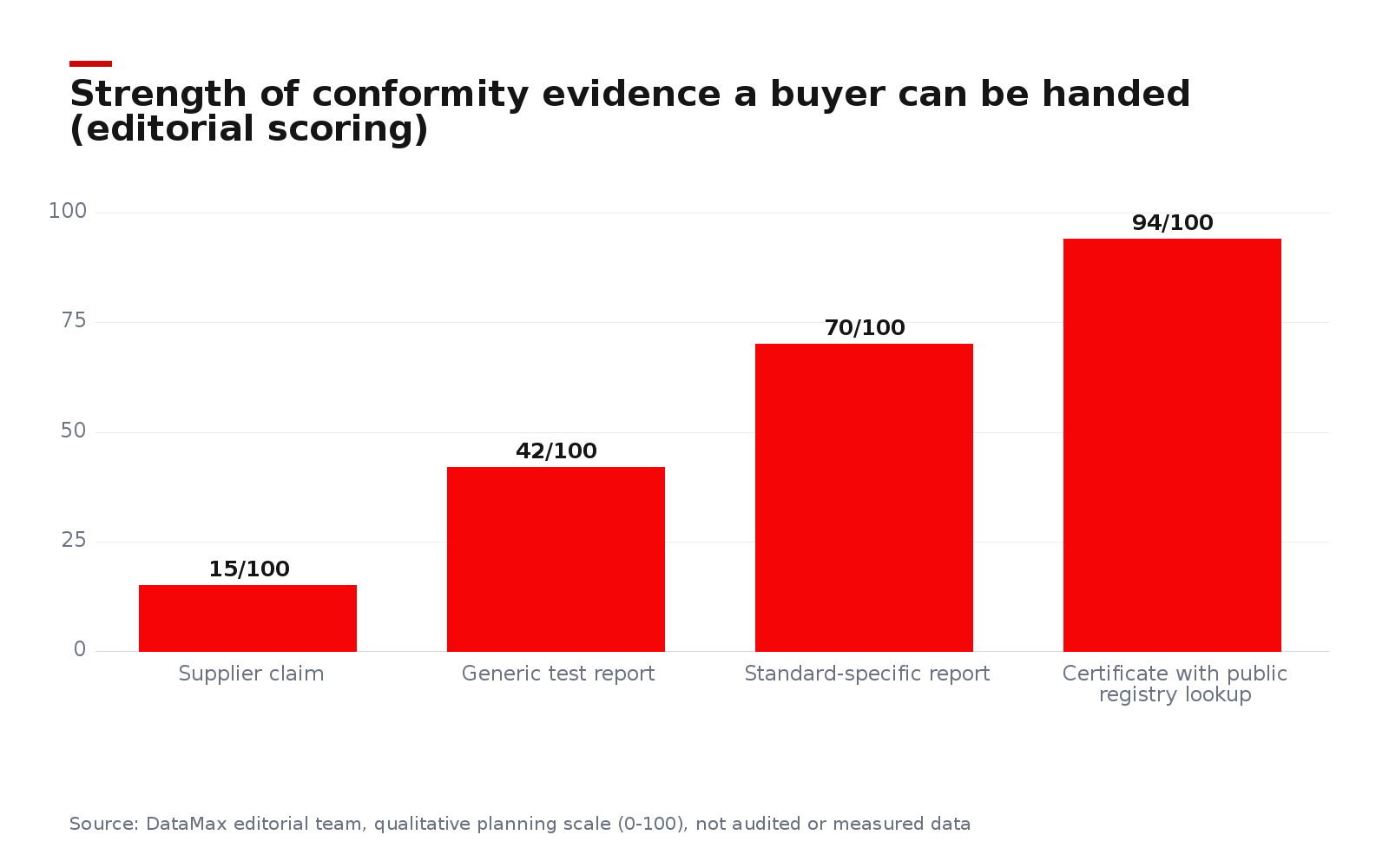
The same figures, in searchable form:
| Evidence option | Editorial score |
|---|---|
| Supplier claim | 15/100 |
| Generic test report | 42/100 |
| Standard-specific report | 70/100 |
| Certificate with public registry lookup | 94/100 |
Source: DataMax editorial team, qualitative planning scale (0-100), not audited or measured data.
The practical comparison is “traceable certificate package versus supplier statement.” Hardware specifications still determine deployment fit, but they do not close the collection task. The RFQ inquiry should include the proposed model, exact configuration, evidence artifacts, required registry lookup, destination, and date for the compliance response.
For a high-volume operator order, the entry tier may simplify fleet administration because the image and configuration can be held stable. For a premium deployment, the evidence request must separate product claims from regulatory identity with greater precision. Neither tier permits a buyer to skip model mapping, registry verification, sample acceptance, and receiving reconciliation.
The comparison should also identify document ownership. In an operator programme, the supplier may own the approval record while the operator owns middleware acceptance. In a distributor shipment, the distributor may collect documents but cannot alter the approved configuration. Assign one evidence custodian and one release approver for each deployment programme.
Where the terminology comes from
The terminology matters because several documents can appear beside a procurement file without serving the same legal or technical function. A type-approval record addresses an identified product against a defined regulatory requirement. A test report records the outcome of a defined evaluation. A certificate may reference a specific applicant, model, technical configuration, and validity condition. A registry entry provides the public lookup route, but the registry record and supplier product map still require reconciliation.
telecommunications type approval is used here in its procurement sense: obtaining evidence that a communications or connected-device product has completed the relevant conformity route and that the offered configuration falls within the approved scope. The exact regulatory mechanism, applicable category, and accepted evidence form must come from the Saudi authority or another authority designated for the product. Do not infer that an EMC, RF, safety, or cybersecurity document automatically constitutes the required type approval.
The architecture behind a connected Android TV box has four independently controlled layers. Layer one is the physical and radio design: PCB, SoC, memory, Wi-Fi/Bluetooth radio, antenna, enclosure, and power supply. Layer two is the system software: AOSP or operator-derived Android image, kernel, drivers, boot configuration, and regional radio settings. Layer three is product identity: label, model number, hardware revision, SKU code, and ordering suffix. Layer four is the deployment service: middleware, DRM configuration, content credentials, updates, and operator management.
Type-approval evidence can attach to a specific boundary within those layers. The evidence file should state which layer it covers. “Model approved” is a weak description if the offer changes the radio, firmware, or production variant. A useful record says what remains fixed and what triggers re-evaluation.
| Term | Procurement meaning | Buyer check |
|---|---|---|
| Type-approval certificate or authorization record | Formal record for the assessed product and defined scope. | Confirm the identifier, responsible holder, model, scope, and validity information. |
| Approved model | Model or variant identified in the formal record. | Match it line by line to the offered configuration. |
| Generic test report | Evidence for a specified test or evaluation. | Confirm whether it supports the exact conformity mechanism claimed. |
| Public registry lookup | Official route for checking identity and status. | Record the lookup identifier, date checked, and result. |
| Configuration mapping | Supplier or authority document linking product variants and technical changes. | Identify approved changes, prohibited changes, and revision control. |
| DRM/security schedule | Commercial and technical protection requirements for the deployment. | Confirm the ordered SKU, license terms, key provisioning, and service ownership. |
| Radio declaration | Description of the radio module, antenna, bands, and associated product configuration. | Reconcile the declaration with the hardware revision and regional operating settings. |
| Certificate condition | Restriction or obligation tied to use, supply, configuration, or another controlled attribute. | Assign each condition to an owner and verify it before release. |
| Configuration equivalence | Written conclusion that a proposed variant corresponds to the assessed scope. | Do not infer equivalence from family naming, appearance, or SoC similarity. |
The wider procurement reference, including the canonical telecommunications type approval support matrix, structures the supplier request. This page addresses the Saudi collection task specifically: gather the official record, map the offered SKU, freeze the production configuration, and retain the verification trail.
telecommunications type approval should also be distinguished from voluntary product certification. A voluntary certificate may demonstrate conformance to a specification without replacing a mandatory conformity route. Likewise, a security or content-protection assessment may be commercially essential while operating outside the radio or telecommunications approval boundary. The evidence register should identify the purpose and authority for each document.
Use a controlled vocabulary in the supplier file. “Certificate,” “report,” “authorization,” “registry entry,” “declaration,” and “configuration mapping” are not interchangeable. A missing document type should be recorded as a missing document type, not absorbed into a general compliance statement. This precision lets the buyer close each requirement without creating a false aggregate conclusion.
Five production SKUs compared
The platform choice determines which configuration enters the Saudi evidence request. The table reproduces only the supplied DataMax product facts; certification status, certificate applicability, and DRM/security configuration must be confirmed against the production datasheet and ordered SKU.
| Model | SoC and CPU | OS | RAM/ROM | Decode and DRM | Ports and connectivity |
|---|---|---|---|---|---|
| DM21P | Amlogic S905Y4, quad Cortex-A35 | AOSP Android 11 | 2GB / 8GB (4GB; 16/32/64GB optional) | AV1 [email protected], VP9/H.265 4K@60, H.264 4K@30; Widevine L1 / PlayReady / HDCP 2.2 optional | HDMI 2.0b out x1, USB2.0 x2, TF, S/PDIF, 3.5mm AV, RJ45 100M, Wi-Fi6 2x2 + BT5.4, DC 5V/2A |
| DM21S | Amlogic S905Y5, quad Cortex-A55 | AOSP Android 14 | 2GB / 16GB (2/4/8GB; 16/32/64GB optional) | AV1 / H.265 [email protected] 4K@60; Widevine L1 / PlayReady optional; Dolby Vision/DTS | HDMI 2.0b out, S/PDIF, AV, USB2.0 x2, TF, RJ45 100M (1G optional), Wi-Fi6 2x2 + BT5.4 |
| DM21T | Amlogic S905X5, quad Cortex-A510 (ARMv9) | AOSP Android 14 | 4GB / 64GB (family options) | H.266/VVC [email protected] 4K@120, AV1/VP9/H.265 4K@120, AVS3 4K@120, H.264 4K@60; inline AI-SR; Widevine L1 / PlayReady optional | HDMI 2.0b out (no HDMI in), USB2.0 x1 + USB3.0 x1, TF, S/PDIF, AV, RJ45 100M (1G opt), Wi-Fi6 + BT5.4 |
| DM22Q | Amlogic S905X5M, quad Cortex-A55 up to 2.5GHz | AOSP Android 14 | 4GB / 64GB (2/4/8GB; 16/32/64GB optional) | AV1/H.265 L5.1 4K@60; inline AI-SR (no NPU TOPS stated); Widevine L1 / PlayReady optional; Dolby Vision/DTS | HDMI 2.0b out, USB2.0 x2, TF, S/PDIF, AV, RJ45 100M (1G opt), Wi-Fi6 2x2 + BT5.4 |
DM21P fits a 4K IPTV or operator middleware deployment and is the relevant starting point when managed operator software drives the fleet. DM21S fits a 4K Android TV box for IPTV/OTT white-label use. DM21T serves premium UHD or cloud-gaming workloads, while DM22Q is gaming-oriented. These are fit statements, not substitutes for the approval mapping.
For each SKU, the RFQ must name the exact offered RAM/ROM because the supplied facts include multiple configurations. The record must also establish the production radio, Android baseline, middleware or retail image, port population, and any optional security features. The collection then moves from catalogue identity to ordered identity. For telecommunications type approval, the DataMax model name is only the starting key.
A procurement example makes the distinction concrete. A hotel group selects DM21S for a white-label deployment and asks DataMax to confirm the production RAM/ROM, Android baseline, radio option, and approved-model mapping. The supplier answers with one certificate identifier and a configuration statement. The buyer still records the registry result, verification date, sample identity, and receiving checklist. The model comparison identifies deployment fit; it does not close the compliance file.
Use the DataMax manufacturing and custom development routes when the deployment requires an agreed image, branding configuration, or controlled configuration change. The final compliance decision remains SKU-specific.
Before issuing the final compliance schedule, ask DataMax to identify which listed options are present in the ordered unit. Do not assume that an optional memory capacity, network speed, DRM implementation, or security feature belongs to the selected build. Confirm the production datasheet, then compare that result with the certificate mapping and sample record.
The procurement team should also record which facts are not claims of approval. Codec support, Wi-Fi/Bluetooth versions, HDMI configuration, and DRM naming describe product capabilities. They do not establish that the Saudi record covers the production unit. The evidence register must therefore keep capability data, regulatory evidence, and deployment acceptance as separate tables.
For telecommunications type approval, the closeout package is the controlled combination of the ordered configuration, the official record, the public lookup result, the configuration mapping, and the sample-to-shipment match. A catalogue page, a feature comparison, and a generic quality certificate cannot substitute for that combination.
Further reading
- Telecommunications Type Approval: A Cross-Market Matrix
- AOSP vs Google TV guide
- HDR10+ Android TV box guide
- DTS:X Android TV box guide
- DRM compliance solutions
- DataMax DM21P specifications and fit
- DataMax DM21S specifications and fit
FAQ
What should a Saudi procurement RFQ request for an Android TV box?
Request the exact type-approval certificate or authorization record, its identifier, the approved-model mapping, the official registry lookup where available, and the offered hardware, radio, and software configuration. Define which evidence must accompany the sample and production shipment. Generic supplier statements do not establish the same traceability.
Does a catalogue certificate cover every DataMax Android TV configuration?
Do not assume catalogue coverage extends to every optional memory, radio, Android, middleware, or branding variant. Certificates and DRM or security provisions are confirmed for the ordered SKU, with the production datasheet and configuration mapping providing the controlling detail.
Can a sample approval replace the type-approval record?
No. Sample testing can verify physical identity, interfaces, radio configuration, output, and software behaviour. It cannot replace the formal record, public lookup, or written mapping showing that the offered production configuration remains within the approved scope.
What should happen when the certificate names a different model?
Quarantine the approval status and request authoritative model mapping or an updated record. A label, feature similarity, or SoC family relationship is insufficient evidence. Procurement should not describe the configuration as approved until the identity chain is closed in writing.
Which DataMax model should enter a Saudi IPTV evidence request?
Choose from deployment fit first: DM21P for operator middleware, DM21S for IPTV/OTT white-label, DM21T for premium UHD or cloud-gaming workloads, and DM22Q for gaming-oriented use. Freeze the exact configuration and confirm its regulatory and DRM/security position per SKU.
Who should own the evidence collection?
Name one accountable supplier owner and one buyer approver. The supplier should maintain the certificate, mapping, manufacturing traceability, and change notices; the buyer should verify the registry record, sample equivalence, and final purchase-order match. Integrators and operators should receive controlled copies without inferring approval from a datasheet.




