

Before the terminology: the decision
If the operator controls the interface, middleware, updates, and device policy, select a controlled deployment platform. If the buyer needs a retail-ready television experience with an operator-integrated application, select an updatable, application-ready platform. Most readers begin on the second side, but the correct choice depends on who controls the post-sale relationship.
The procurement decision is not simply “Android version A versus version B.” A manufacturer should be able to explain four separate fields: the operating-system baseline, the operator-owned middleware layer, the update and device-management mechanism, and the commercial terms attached to that layer. These fields often appear as one line in an RFQ even though they create different liabilities.
This article focuses on that angle rather than repeating a general vendor-selection guide. For the broader buying process, use the TV box vendor selection checklist as the canonical reference. Before a sample order or production discussion, ask the manufacturer to identify each OS layer in writing, attach the relevant authorization evidence, and freeze the exact SKU configuration in the purchase order. A verbal assurance that a platform is “operator-ready” is not a substitute for a reproducible build definition.
Procurement teams often ask for an OS version first because it is the easiest visible item to compare. That sequence is backwards. The responsible manufacturer should first establish the owner of the user interface and the update path, then identify the operating-system baseline that can support those responsibilities. If the operator owns authentication and entitlement, a generic launcher can waste integration effort. If the operator supplies only the application, a full middleware engagement can add unnecessary cost and delay.
The decision has two viable outcomes. A controlled deployment configuration provides the manufacturer with a named baseline, repeatable build, test method, and update responsibility. An application-ready configuration provides a stable hardware and OS combination, a defined application path, and a clear boundary between standard delivery and customer-specific integration. Neither outcome is universally better. A pilot with a controlled batch may need only reproducible images and acceptance records. A large operator fleet may need signed rollout, rollback, recovery, device identity, and an escalation route because failure affects service activation.
Before comparing models, write one sentence naming who controls the launcher, who can publish a firmware update, who signs the application, who monitors devices, and who answers a failed-update escalation. If the manufacturer cannot produce that sentence, the RFQ is not yet specific enough for a meaningful comparison.
Where quotations quietly diverge
Two quotations can describe the same device as “Android 11” or “Android 14” while pricing materially different commitments. One may cover a stock image with an operator-installed application; the other may include a signed AOSP build, security updates, middleware adaptation, regional certification, and reproducible provisioning. The mismatch is usually created by undefined scope, not by a visible hardware difference.
Field trap 1
A quotation that lists an AOSP Android release without separating Google-certified Android TV from an AOSP build leaves certification, application compatibility, update ownership, and distribution rights unresolved. Require the exact software identity and applicable authorization evidence.
A second divergence concerns updates. “OTA support” may mean image delivery over HTTP, secure signed packages, staged rollout, rollback, automatic recovery, or a managed fleet service. Each implies different engineering effort, integration work, and operational risk. A low quotation that includes only image files may force the operator to build and maintain the delivery system later.
Field trap 2
A device described as “DRM ready” does not establish which service level is licensed, which keys are provisioned, which application is certified, or whether the operator can manage the licence service. Name the DRM, application, device, and service obligations in the quotation.
The same divergence appears in accessories, power supply, packaging, and regional approval. One manufacturer may assume that HDMI cables, stands, remote controls, and regional inserts are customer-supplied. Another may include them in the shipment plan but omit the part numbers from the quotation. An operator can approve a working sample and then receive a production shipment fitted with a different remote, power adapter, or Wi-Fi module. The resulting mismatch is not a software defect, but it can stop deployment just as effectively.
A third divergence is the meaning of “custom.” It can refer only to a preloaded launcher, a branded boot image, a modified application, a middleware integration, a new device-management workflow, or a fully controlled image-signing process. Ask the manufacturer to enumerate the artifacts: boot logo, system application, launcher package, build identifier, signing certificate, provisioning profile, update package, test report, and acceptance record. Each artifact should have an owner and a delivery date.
A fourth divergence concerns support. “Six months of support” might mean answering software questions, reproducing a defect, maintaining the bootloader, rebuilding an image, or operating a monitored fleet service. Define the incident channel, severity levels, response action, required evidence, and escalation to engineering. The contractual duration alone does not reveal what the manufacturer will actually do when a unit loses network access after an interrupted update.
Procurement should normalize every response into four fields:
- OS baseline and device type.
- Middleware, UI, application, and integration scope.
- Update, security, and device-management scope.
- Commercial dependencies, deliverables, and acceptance criteria.
The cost of an omitted field appears later as blocked certification, duplicated engineering, fleet inconsistency, or a dispute over which party owns a failed update. The quotation should identify excluded work as plainly as included work. A useful clause states: “This quotation includes the named build, integration, testing, and evidence deliverables; all other middleware, certification, device-management, or regional obligations are excluded and listed as customer dependencies.”
Questions to put in the supplier review
A qualified manufacturer should connect the software commitment to production evidence. The review should trace a requirement from customer requirement to board, firmware image, test, serial-number record, and shipment. Requesting a generic quality presentation is weaker than asking for evidence tied to the quoted configuration.
- Fix the baseline Ask for the exact AOSP Android version, product type, build identifier, security-patch level, kernel, bootloader policy, and authorized update path. Require a statement identifying what the manufacturer supplies and what remains customer-owned.
- Trace manufacturing control Review PCB assembly, SMT, AOI, fixture testing, firmware flashing, aging, dark-room or display verification, and audit records for the actual product family. Evidence must connect to the quoted SKU and production period.
- Test the software path Define boot, update, rollback, network recovery, application launch, DRM playback, HDMI output, remote-control behavior, and operator-provisioning tests. Record serial numbers and results against a controlled firmware build.
- Validate deployment Request the intended update mechanism, device-management relationship, certificate process, application-signing process, and fleet-support escalation route. Confirm against the deployment model rather than a laboratory demonstration.
- Freeze acceptance Attach the BOM, RAM/ROM selection, ports, OS baseline, middleware scope, firmware build, test protocol, certificates, and sample approval to the purchase order. Any substitution then requires written approval.
Useful request format: “Provide SMT/AOI/aging evidence for the quoted product family, plus the build identifier, firmware-flashing record, dark-room test method, sample serial-number trace, and update/rollback demonstration. Identify which records are factory evidence and which are customer-specific deliverables.”
SMT inspection alone does not validate Android boot reliability. AOI detects assembly defects within defined coverage; it does not prove that a DRM application plays, that an OTA package rolls back, or that a serial-number record matches the correct firmware. The evidence chain must cover hardware, software, identity, and deployment.
Ask the manufacturer to explain the route from an engineering change to the production line. The change should identify the affected board revision, firmware component, firmware build, affected test scripts, factory instruction, and records generated during the run. If a component substitution changes the Wi-Fi module, remote-control receiver, power supply, or storage configuration, the manufacturer should state whether the previous approval remains valid. A silent substitution creates a traceability gap even when the enclosure is unchanged.
The review should also test exception handling. Ask what happens when AOI flags a component, an aging unit fails to boot, a display test finds an intermittent HDMI output, or a firmware-flashing station cannot record a serial number. Identify the hold mechanism, responsible role, retest rule, and release authority. The useful evidence is not a declaration that defects are “prevented”; it is a repeatable rule that prevents an unresolved unit from entering the shipment population.
For a factory-side review, request factory quality evidence and ask for SMT/AOI and aging records tied to the proposed build. The manufacturer should explain which tests are automated, which are sampled, and how exceptions prevent shipment. Sampling policies, golden samples, test limits, and corrective-action ownership belong in the acceptance plan.
A software-aware review should go one step further. Require the manufacturer to show the relationship between a serial number, a hardware revision, a firmware build, a test result, and the packaging record. A demonstration on a development unit is not sufficient. The sampled production unit should carry the same hardware revision and approved firmware as the order. Any different treatment of engineering samples, pilot units, and mass-production units must be visible before shipment.
The comparison buyers actually make
Buyers often compare an entry configuration with a committed deployment configuration, even when both use the same board. The difference is not simply hardware tier. It is the amount of software, certification, lifecycle, and operational work the manufacturer controls.
| Decision field | Entry configuration | Committed deployment configuration |
|---|---|---|
| OS baseline | Named AOSP Android release | Named AOSP build, patch level, bootloader and update policy |
| User experience | Customer application or standard launcher | Operator middleware, managed UI and integration acceptance |
| Update mechanism | Image and basic OTA deliverables | Signed rollout, staging, rollback, recovery and ownership definition |
| Device management | Customer-operated provisioning | Android Management or operator-specified deployment workflow |
| DRM scope | Named DRM capability | Application/device/service qualification and licence operations |
| Compliance | General regional requirement list | Target-market certificates, test evidence and delivery responsibility |
| Production record | Sample and family-level records | SKU-, firmware-, serial- and shipment-linked evidence |
| Application signing | Customer signs and installs | Named signing authority, key handling and release procedure |
| Change control | Ad hoc substitution | Written approval for hardware, firmware and accessory changes |
| Support escalation | General technical inquiry | Defined severity, owner, response action and engineering escalation |
| Acceptance | Visual sample check | Functional protocol covering boot, playback, update and recovery |
| Logistics | Generic carton and accessories | Frozen packing list, labels, inserts and serial allocation method |
This comparison prevents false economies. If an operator expects to manage thousands of deployed units, a basic image handover can shift engineering and service obligations into the operator’s team. If a pilot needs a fixed set of features on a controlled batch, a full fleet-management engagement can add work without improving the pilot.
The comparison should be expressed as an acceptance matrix, not as marketing language. For each OS field, identify the deliverable, evidence, owner, dependency, and acceptance method. A manufacturer may coordinate a subsystem supplied by another party, but the quotation still needs a named responsibility and an escalation route.
No single field should be collapsed into another. The OS baseline is not the middleware. The middleware is not the OTA service. OTA is not DRM licensing. Certification is not a substitute for customer acceptance testing.
Consider a concrete white-label comparison. Configuration A supplies the named AOSP image, preloads the customer application, and hands over basic files. Configuration B defines launcher ownership, application signing, staged update behavior, serial-number traceability, target-market evidence, and a customer acceptance protocol. If both quotations name the same processor and RAM, the latter still contains the commitments that determine launch readiness. The manufacturer should price those commitments separately rather than hide them in a single “customization” line.
The reverse comparison matters as well. A controlled operator deployment may not need a branded retail launcher, broad application certification, or a consumer-style presentation layer. It may need a stable boot path, operator middleware, provisioning, entitlement handling, and recovery. A manufacturer that proposes those features by default may misunderstand the deployment and add integration effort. Procurement should remove unnecessary scope while preserving every field that affects control.
Definitions a buyer cannot outsource
AOSP Android is the open-source software platform supplied as a baseline for device implementation. An Android TV device type, when applicable, governs the application and interface framework; it should not be inferred merely from the word “Android.” Require the manufacturer to name the product type and any Google authorization status applicable to the exact build and target market.
Operator middleware sits between the OS and the operator’s service layer. It can include launcher behavior, authentication, entitlement presentation, telemetry, device identity, application integration, and operator-specific UI. The middleware boundary must be described through interfaces and responsibilities, not only through screenshots.
Android Management API is a framework for managing Android device policy, enrollment, and organization-owned applications. It supports a managed deployment architecture but does not itself define firmware, application signing, content protection, or network provisioning.
Widevine L1, PlayReady, and HDCP serve different parts of the content chain. Widevine and PlayReady are software DRM systems; HDCP protects content transmitted over interfaces such as HDMI. A platform listing a DRM name or version does not, by itself, prove that the intended application, model, and service configuration have completed qualification.
OTA covers over-the-air software delivery, but an operational design also needs identity, package signing, rollout control, failure reporting, retry, rollback, and recovery. TR-069 is a remote device-management protocol used in broadband equipment ecosystems; a project using it still needs a defined data model, agent integration, and operational workflow.
HDMI 2.0b, USB 2.0, and USB 3.0 are interface specifications, not guarantees of application throughput or device behavior. Likewise, “4K” should be tied to a resolution, frame rate, chroma format, codec profile, and output path where the project depends on those details.
A buyer should write the requirement as an observable contract. Instead of “the manufacturer provides a secure Android platform,” specify the boot behavior, identity mechanism, update package, signing authority, rollback behavior, application entitlement, DRM path, network dependency, logging output, and acceptance environment. Definitions reduce the chance that each party assumes the other owns the missing step.
The manufacturer should also distinguish the device image from the customer application. The image establishes the boot state, framework configuration, preinstalled components, permissions, and recovery baseline. The application establishes the service workflow. A signed build reference can confirm which image was tested, but it cannot establish whether the application was signed with the production key, whether entitlement calls work against the intended environment, or whether the middleware has the required API.
For device management, write the enrollment path explicitly. If Android Management is used, identify the management authority, enrollment credential, policy owner, application assignment rule, and behavior when a device is factory reset. If the operator uses another orchestrator, state the supported trigger, network dependency, reporting interface, and failure action. The manufacturer must not assume that a generic “managed Android” label describes the fleet’s actual control plane.
For updates, define what happens before, during, and after delivery. “Before” requires a validated package and target cohort. “During” requires signing, transfer, installation behavior, power-loss handling, and progress reporting. “After” requires success confirmation, failure reporting, retry, rollback, and exception visibility. These are separate acceptance points. Without that sequence, an OTA claim remains untestable.
For certification, distinguish platform capability from a completed program. The manufacturer may support the build, integrate the application, and provide test evidence. The customer or service provider may own credentials, account registration, licence agreements, or content-provider approval. The purchase order should identify each dependency and the evidence required for release.
Real DataMax platforms, field by field
The following comparison uses only the supplied DataMax product facts. Configured options are identified as options rather than base specifications. For a purchase order, confirm the exact SKU against the production datasheet.
The base memory configurations are deliberately limited to the charted values; optional RAM tiers must be fixed line by line in the purchase order.
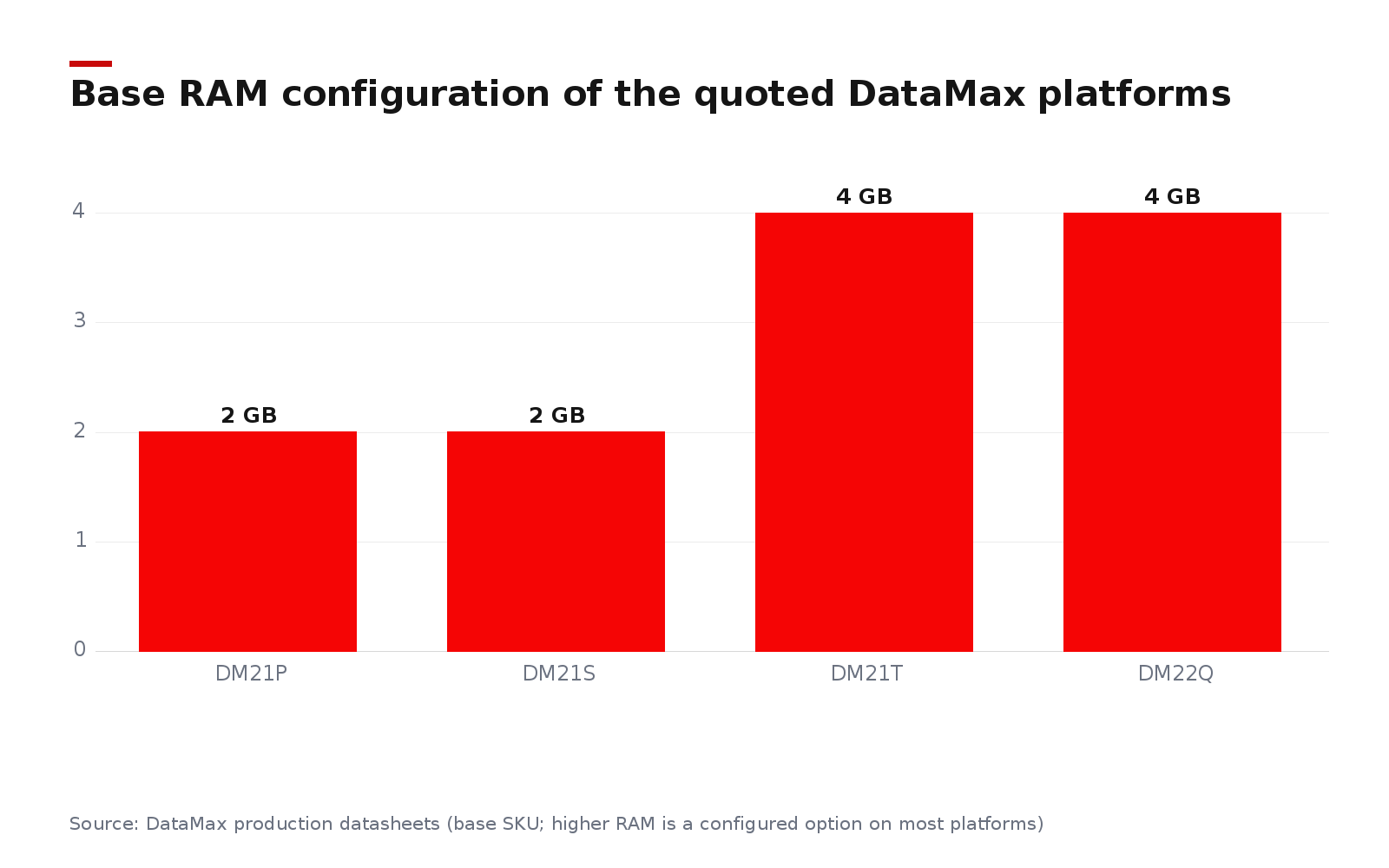
The same figures, in searchable form:
| Platform | Base RAM |
|---|---|
| DM21P | 2 GB |
| DM21S | 2 GB |
| DM21T | 4 GB |
| DM22Q | 4 GB |
| Model | Processor and OS | Memory | Media and DRM | Interfaces |
|---|---|---|---|---|
| DM21P | Amlogic S905Y4, quad Cortex-A35; AOSP Android 11 | 2GB / 8GB; 4GB and 16/32/64GB optional | AV1 [email protected]; VP9/H.265 4K@60; H.264 4K@30; Widevine L1 / PlayReady; HDCP 2.2 optional | HDMI 2.0b out x1; USB2.0 x2; TF; S/PDIF; 3.5mm AV; RJ45 100M; Wi-Fi6 2x2 + BT5.4; DC 5V/2A |
| DM21S | Amlogic S905Y5, quad Cortex-A55; AOSP Android 14 | 2GB / 16GB; 2/4/8GB and 16/32/64GB optional | AV1 / H.265 [email protected] 4K@60; Widevine L1 / PlayReady optional; Dolby Vision/DTS | HDMI 2.0b out; S/PDIF; AV; USB2.0 x2; TF; RJ45 100M with 1G optional; Wi-Fi6 2x2 + BT5.4 |
| DM21T | Amlogic S905X5, quad Cortex-A510 (ARMv9); AOSP Android 14 | 4GB / 64GB; family options | H.266/VVC [email protected] 4K@120; AV1/VP9/H.265 4K@120; AVS3 4K@120; H.264 4K@60; inline AI-SR; Widevine L1 / PlayReady optional | HDMI 2.0b out with no HDMI in; USB2.0 x1; USB3.0 x1; TF; S/PDIF; AV; RJ45 100M with 1G optional; Wi-Fi6; BT5.4 |
| DM22Q | Amlogic S905X5M, quad Cortex-A55 up to 2.5GHz; AOSP Android 14 | 4GB / 64GB; 2/4/8GB and 16/32/64GB optional | AV1/H.265 L5.1 4K@60; inline AI-SR; Widevine L1 / PlayReady optional; Dolby Vision/DTS | HDMI 2.0b out; USB2.0 x2; TF; S/PDIF; AV; RJ45 100M with 1G optional; Wi-Fi6 2x2 + BT5.4 |
The field differences support procurement segmentation. DM21P is positioned for 4K IPTV and operator middleware set-top-box use. DM21S is positioned for 4K Android TV IPTV/OTT white-label use. DM21T is positioned for premium UHD and cloud-gaming applications, while DM22Q is positioned for gaming-oriented Android TV use. These are fit descriptions, not proof that a particular middleware, application, or certification is included.
DM21P provides a 2GB / 8GB base configuration with 4GB and 16/32/64GB optional. Its documented interfaces include one HDMI 2.0b output, two USB2.0 ports, TF, S/PDIF, 3.5mm AV, RJ45 100M, Wi-Fi6 2x2 with BT5.4, and DC 5V/2A. The manufacturer should confirm whether a selected memory option changes the exact ordering code and evidence package.
DM21S provides a 2GB / 16GB base configuration with 2/4/8GB and 16/32/64GB options stated. Its documented network option is RJ45 100M with 1G optional. The quotation should identify whether the order requires the 100M or 1G configuration, because an interface statement without a selected option is not a frozen hardware definition.
DM21T provides a 4GB / 64GB base configuration within a family-option set. Its media field includes H.266/VVC [email protected] 4K@120, AV1/VP9/H.265 4K@120, AVS3 4K@120, and H.264 4K@60, with inline AI-SR. Its HDMI 2.0b output has no HDMI input. A procurement line for capture, game passthrough, or external source input must therefore test the actual interface requirement rather than infer an input path.
DM22Q provides a 4GB / 64GB base configuration, with 2/4/8GB and 16/32/64GB options stated. Its media field includes AV1/H.265 L5.1 4K@60 and inline AI-SR. No NPU TOPS value is stated, so procurement must not request performance evidence based on an unstated TOPS figure. The manufacturer should document the exact gaming features, output modes, and acceptance tests included in the quoted scope.
For all four platforms, request the exact production datasheet, software build, selected memory option, target-market certification list, middleware scope, update scope, and application/DRM acceptance method. Do not infer an unlisted Android TV authorization, update service, or certification from the model designation.
Buyer situations, ranked by what they punish
Deployment situations expose different weaknesses. An IPTV operator is punished by an unreliable boot or update path because its subscribers directly experience it. An integrator may be punished by missing interfaces or a launcher that disrupts a control system. A venue operator may be punished less by peak codec performance than by unattended recovery and simple device management.
| Situation | Primary requirement | Secondary risk | Model direction |
|---|---|---|---|
| IPTV operator with middleware | Controlled OS baseline, middleware integration, update and recovery | Field inconsistency blocks service activation | DM21P for 4K IPTV / operator middleware set-top-box fit |
| IPTV/OTT white-label program | AOSP Android 14 base with launcher, application and branding integration | Launcher or update scope is misunderstood | DM21S for 4K Android TV IPTV/OTT white-label fit |
| Premium UHD or cloud-gaming program | High-frame-rate media path and stronger base memory configuration | HDMI input, output capability or bandwidth assumptions conflict with the requirement | DM21T for premium UHD / cloud-gaming fit |
| Gaming-oriented Android TV program | Gaming-oriented platform with AV1/H.265 4K@60 and 4GB / 64GB base | Marketing resolution claims exceed the datasheet | DM22Q for gaming-oriented Android TV fit |
| Digital-signage or hospitality deployment | Remote recovery, controlled application behavior and unattended operation | Device management, signing and deployment ownership remain undefined | Select by confirmed OS, interface and management evidence; confirm against the production datasheet |
A modern electronics production line illustrates the hardware side of this decision: automated placement, inspection, firmware loading, and final test must connect to the same serial-number record as the shipped software.

For an operator, the software acceptance test should include a forced update interruption, recovery from a failed package, entitlement revalidation, and a controlled restart. The test should also cover loss of network access, an unavailable service endpoint, and reconnection without manual intervention. A manufacturer that supports the platform should specify which failures trigger automatic recovery, which require a new signed image, and which are visible to the operator.
For an integrator, the test should include the actual control interface, display matrix, network design, application workflow, and peripheral inventory. Check CEC behavior where required, remote-control pairing, Ethernet connectivity, USB peripheral attachment, and audio routing. Do not let a platform fit label substitute for the control-room acceptance script. The manufacturer should receive the integrator’s interface list before finalizing the hardware and firmware configuration.
For a venue deployment, the test should include central recovery and the actual monitoring relationship. Define what happens after power restoration, network disconnection, application crash, storage exhaustion, and accidental reboot. If the venue cannot maintain a permanent engineering contact, the operator must decide whether the manufacturer or a managed service provider owns first-line monitoring.
A retailer or distributor faces a different failure mode: the boxed product must present the intended interface at first power-on, carry the correct accessories, and enter a recoverable state after a customer reset. The acceptance test should include out-of-box presentation, reset behavior, account or activation flow, remote pairing, packaging contents, and a clear escalation path for missing components. The manufacturer should provide the same evidence used for operator deployment rather than treating retail units as a separate untested product class.
Rank situations by consequence, not by feature count. An operator prioritizes recovery and identity. An integrator prioritizes interfaces and deterministic control. A venue prioritizes unattended operation. A distributor prioritizes out-of-box consistency. These situations do not rank the models by general quality. They rank the consequence of failure. The same platform can be suitable for one deployment and commercially wrong for another if middleware ownership, firmware support, or acceptance criteria differ.
A decision path for the RFQ
Start by assigning ownership, not by selecting an OS label. The procurement team and manufacturer should complete the decision path in this order and convert each result into a specification line.
- State ownership Paste: “The operator owns [middleware/UI/identity/entitlement] updates. The manufacturer provides [baseline image/device services]. Changes require [approval process].”
- Name the release Paste: “The approved baseline is AOSP Android [version stated in the DataMax production datasheet], with [product type], security-patch level [value], bootloader [policy], and firmware build [identifier].”
- Define the update path Paste: “Updates use [mechanism], signed by [party], with staging, retry, rollback, recovery, logging, and fleet-management responsibilities listed in the acceptance schedule.”
- Lock configuration Paste: “The PO fixes model [PDP reference], RAM [value], ROM [value], ports, accessories, firmware build, regional requirements, and any approved substitutions.”
- Attach evidence Paste: “SMT/AOI/aging evidence, flashing records, dark-room test method, sample serial-number trace, update/rollback demonstration, and certificates must cover the quoted SKU and production period.”
For a factory audit, request SMT/AOI, aging, and firmware-loading evidence specific to the proposed platform through DataMax manufacturing capability. The audit should seek traceability rather than a staged demonstration. Identify which processes are automated, which exceptions block shipment, and how a software build is linked to hardware records.
Before issuing the RFQ, ask the manufacturer to resolve three contradictions. First, confirm that the named OS release matches the approved image and the product type. Second, confirm that the selected RAM, ROM, and optional Ethernet configuration match the sample. Third, confirm that the DRM, codec, and interface claims represent the datasheet fields rather than broader marketing language. A response that requires several paragraphs to reconcile those points is a commercial risk, not merely a documentation issue.
Use a quote-comparison sheet with one column per field and one row per deliverable. Enter the exact wording returned by each manufacturer, not a shortened internal summary. Mark “included,” “excluded,” “customer dependency,” “optional,” and “unconfirmed” separately. “Unconfirmed” is actionable: it identifies the question that must block the purchase order. “Optional” is also insufficient until the selected option, its effect on the SKU, and its test impact are written.
The RFQ should request the production datasheet, exact ordering code, build identifier, security-patch statement, bootloader policy, update mechanism, application-signing responsibility, target-market certification scope, middleware deliverables, packaging list, and traceability evidence. It should define the sample approval as a configuration-specific milestone. A design win based on a general evaluation unit should not authorize a mass-production order until the production build matches the approved function.
A practical approval rule prevents silent drift: no change to processor, memory configuration, wireless or Ethernet option, output interface, remote-control hardware, power supply, operating-system baseline, middleware version, signing authority, or target-market requirement without written approval. The manufacturer should quote the affected test plan and certification impact of each proposed substitution.
Email [email protected] with the requested SKU list, target-market certificate requirements, and middleware/DRM checklist. Include the intended OS ownership model, sample approval status, and the evidence required for the sample order. A useful final decision is not “the Android 14 model,” but “this exact model, configuration, software scope, evidence set, and acceptance method.”
Further reading
- Guide tv box vendor selection checklist
- Google TV devices
- AV1 Android TV box guide
- AOSP vs Google TV guide
- HDR10+ Android TV box guide
- DataMax DM21P specifications and fit
- DataMax DM21S specifications and fit
FAQ
What are the four OS fields in a streaming-box RFQ?
The four fields are the operating-system baseline, operator middleware and user experience, update and device-management mechanism, and commercial/certification obligations attached to the software. They should be quoted separately. A stated Android version identifies a baseline but does not define middleware work, rollback, provisioning, DRM service, or target-market approval. Procurement should require written ownership for each field from the manufacturer.
Should an IPTV operator require Android TV rather than AOSP?
The requirement depends on the product, interface, application ecosystem, and target market. An operator may need an operator middleware set-top box built around AOSP rather than a consumer television interface. Ask the manufacturer to identify the exact product type, authorization status, application requirements, and UI ownership. Do not infer Android TV certification from an AOSP Android release or from a model name.
Who should own Android OTA updates?
Ownership depends on the deployment architecture, but the quotation must name the party responsible for image creation, signing, rollout, rollback, recovery, monitoring, and fleet support. An operator may own policy and orchestration while the manufacturer maintains the image and update mechanism. Accept the division only after testing interruption handling, failed-package recovery, staged rollout, and the operational escalation route.
Does Widevine L1 confirm that a box is DRM-ready?
No. Widevine L1 is a DRM level, not a complete deployment qualification. The operator must also verify the device model, application, service configuration, licence workflow, output path, and relevant content-protection requirements. PlayReady and HDCP address separate parts of the content chain. The purchase order should specify the intended application and acceptance evidence rather than relying on a DRM label alone.
What evidence should a factory provide before a production commitment?
Request evidence tied to the quoted SKU and production period: SMT and AOI records, firmware-flashing traceability, aging or burn-in results, display or dark-room testing, serial-number mapping, sample serial trace, and a signed build reference. For software-enabled programs, add an update, rollback, recovery, and application acceptance record. This chain verifies that the approved sample corresponds to the production process and the same manufacturer responsibility.
How should RAM and ROM be written in the purchase order?
Write the selected RAM and ROM values as separate line items tied to the model and hardware revision. Base configurations are not automatically every available configuration. For DataMax platforms, confirm the production datasheet, especially where 2GB, 4GB, 8GB, 16GB, 32GB, or 64GB options are stated. A firmware approval should identify the exact memory configuration used for testing.




