
The short answer first
| Decision axis | OEM/private-label route | ODM/co-development route |
|---|---|---|
| Primary control | Brand identity, packaging, boot presentation, and selected firmware behavior | Hardware architecture, BSP, middleware, applications, certification, and lifecycle controls |
| Commercial boundary | Defined branding package with limited technical variation | Joint requirements, change control, acceptance tests, and engineering ownership |
| Best fit | OTT, white-label, and distribution programs requiring recognizable hardware | Operator, IPTV, managed-device, and differentiated service deployments |
| Buyer proof | Approved artwork, launcher specification, sample and production inspection | Requirements traceability, software branch governance, regression evidence and field-update plan |
| Main commercial trap | Branding language hides firmware or accessory work | “Custom” remains unbounded without a written change-control process |
The phrase android tv box manufacturer describes a company that can design, manufacture, configure, and support Android TV products, but the phrase alone does not establish engineering depth. Buyers must distinguish an OEM from an ODM, a hardware vendor from a software integrator, a product supplier from a lifecycle operator, and an approved reference design from a production platform. For procurement, the decisive evidence is not a capability slogan; it is the production BOM, software build, test method, and named owner for every deviation.
For a focused comparison of those commercial boundaries, see the canonical guide to Android TV box OEM and ODM: what it is and what it is not. This glossary does not compete with that topic; it provides the terminology, model references, and procurement checkpoints needed to use the distinction correctly. DataMax positions the models below around operator middleware, IPTV/OTT white-label, premium UHD, and gaming-oriented use cases. A manufacturer evaluation should begin with the deployment, not the retail category: middleware and entitlement service for IPTV; operator launcher and payment workflow for managed distribution; visual branding for hospitality; or sustained interface performance for cloud gaming.
Procurement rule: every term below should end in a datasheet field, an RFQ line, a test method, or a signed acceptance record. If the term remains descriptive—such as “optimized,” “premium,” or “operator-ready”—it has not yet defined a deliverable. When evaluating an android tv box manufacturer, require the same evidence for branding, codec, network, DRM, provisioning, and update commitments.
The platform shortlist with datasheet values
| Model and fit | SoC and operating system | Memory and storage | Decode and content path | Connectivity and physical interface |
|---|---|---|---|---|
| DM21P 4K IPTV / operator middleware set-top box | Amlogic S905Y4, quad Cortex-A35 AOSP Android 11 | 2GB / 8GB 4GB; 16/32/64GB optional | AV1 [email protected]; VP9/H.265 4K@60; H.264 4K@30 Widevine L1 / PlayReady / HDCP 2.2 optional | HDMI 2.0b out x1; USB2.0 x2; TF; S/PDIF; 3.5mm AV; RJ45 100M; Wi-Fi6 2x2 + BT5.4; DC 5V/2A |
| DM21S 4K Android TV box for IPTV/OTT white-label | Amlogic S905Y5, quad Cortex-A55 AOSP Android 14 | 2GB / 16GB 2/4/8GB; 16/32/64GB optional | AV1 / H.265 [email protected] 4K@60 Widevine L1 / PlayReady optional; Dolby Vision/DTS | HDMI 2.0b out; S/PDIF; AV; USB2.0 x2; TF; RJ45 100M (1G optional); Wi-Fi6 2x2 + BT5.4 |
| DM21T Premium UHD / cloud-gaming box | Amlogic S905X5, quad Cortex-A510 (ARMv9) AOSP Android 14 | 4GB / 64GB family options | H.266/VVC [email protected] 4K@120; AV1/VP9/H.265 4K@120; AVS3 4K@120; H.264 4K@60; inline AI-SR Widevine L1 / PlayReady optional | HDMI 2.0b out (no HDMI in); USB2.0 x1 + USB3.0 x1; TF; S/PDIF; AV; RJ45 100M (1G opt); Wi-Fi6 + BT5.4 |
| DM22Q Gaming-oriented Android TV box | Amlogic S905X5M, quad Cortex-A55 up to 2.5GHz AOSP Android 14 | 4GB / 64GB 2/4/8GB; 16/32/64GB optional | AV1/H.265 L5.1 4K@60; inline AI-SR (no NPU TOPS stated) Widevine L1 / PlayReady optional; Dolby Vision/DTS | HDMI 2.0b out; USB2.0 x2; TF; S/PDIF; AV; RJ45 100M (1G opt); Wi-Fi6 2x2 + BT5.4 |
The selection logic is intentionally narrower than a general ranking. DM21P fits an operator middleware program where the supplied facts identify an IPTV and operator set-top-box role. DM21S fits a white-label IPTV or OTT program. DM21T addresses premium UHD and cloud-gaming requirements, including stated 4K@120 decode paths and inline AI-SR. DM22Q addresses a gaming-oriented role with a different SoC, memory baseline, and stated decode profile. A buyer comparing an android tv box manufacturer should start with the service stack, then use these model directions to identify the candidate platform.
Do not convert a codec capability into an output capability without confirmation. The DM21T datasheet caps output and decode at 4K, and the DM22Q maximum is 4K@60; marketing labels that imply 8K do not override those limits. The same rule applies to Ethernet: the listed RJ45 100M configuration must not be represented as 1G unless the production configuration confirms the optional 1G option. Codec support also does not establish application-level playback, DRM licensing, or display certification.
A procurement example makes the distinction operational. If an operator needs a wired IPTV box with a specified middleware image, DM21P is a candidate, but the order still needs the exact Ethernet speed, storage configuration, DRM selection, operator application, remote-control implementation, and provisioning sequence. The model name establishes the platform direction; it does not complete the technical order.
A second example concerns white-label OTT. DM21S has AOSP Android 14 and a 2GB / 16GB stated configuration, but the buyer must decide whether 1G Ethernet is required, whether Dolby Vision and DTS are part of the production configuration, and which launcher resources are included. A quotation listing the model without those selected fields remains materially incomplete. The same incomplete quotation often reaches an android tv box manufacturer review with a single product line and no acceptance matrix.
For buyers defining an RFQ around this hardware set, the first message to DataMax should contain the target model, operating-system baseline, memory and storage, required codecs, DRM, HDMI behavior, network interface, branding depth, and destination market. Send that request through the RFQ form; the 4K 60fps Android TV box guide helps separate display capability, decode capability, and device-level playback behavior.
The family comparison should also be treated as a configuration review rather than a substitute for the production datasheet. Optional storage, 1G Ethernet, HDCP 2.2, Dolby Vision, and DTS are not interchangeable entitlements. Each option needs an explicit BOM designation, a test method where applicable, and an approval record. This discipline keeps the shortlist useful for a commercial evaluation without converting optional data into unconditional product claims.
How the requirement actually works
OEM, ODM, and the operating-system boundary
OEM means that the brand owner defines the product, appearance, software experience, packaging, and market presentation while another organization manufactures it. ODM places more design and engineering responsibility with the supplier, who may deliver a configured platform for the brand’s application, middleware, launcher, and commercial model. In practice, contracts blend both routes, so the decisive question is which functions each party owns. An android tv box manufacturer can occupy both positions, but the contract should identify actual responsibility rather than rely on the label.
AOSP is the open-source foundation on which the listed platforms are based. AOSP Android 11 or AOSP Android 14 does not automatically mean Google Play, Google Play Services, Widevine device certification, Google TV certification, or a Google-distributed update channel. Widevine L1 and PlayReady identify content-protection implementations; HDCP 2.2 concerns protected-content output rules. Those labels must be separated from application entitlements, operator middleware, and service provisioning.
The contract should express ownership as deliverable pairs. For example, the brand may own artwork while the manufacturer owns boot-image integration; the operator may own the middleware API while DataMax owns BSP stability; the buyer may own app acceptance while the supplier owns device-level regression. If a deliverable has no owner, it sits outside both definitions even when the purchase order mentions “customization.”
Codec, display, and DRM are separate paths
AV1, VP9, H.265, and H.264 are decode capabilities. HDMI 2.0b describes the physical output interface. A platform can decode a signal without representing it as a product-level guarantee for every resolution, refresh rate, app path, and source. The RFQ should therefore state the output target, display target, source format, application, and test method separately.
Likewise, Dolby Vision and DTS appear as optional or identified elements in the supplied DM21S and DM22Q facts. Their presence does not specify license authority, mastering profile, application implementation, or certification status. Confirm those details against the production datasheet. A competent android tv box manufacturer should explain which evidence supports each claim and which party owns remaining application-level validation.
For an engineering team, each arrow requires a failure owner. Application errors can occur before the DRM request, licence failures can occur during policy negotiation, decode errors can occur after buffers reach the media pipeline, and output problems can occur after a valid frame reaches HDMI. A generic playback acceptance test cannot reveal which layer failed. The acceptance matrix should identify the source app, stream format, display mode, expected result, and escalation path.
Operator stack
An operator deployment adds middleware, conditional access or entitlement integration, device identity, network activation, launcher policy, telemetry, and remote support. IPTV may use multicast transport, while OTT commonly relies on unicast delivery through an application and CDN path. The hardware choice must support the actual service delivery and provisioning model rather than a generic “IPTV ready” label.
A multicast IPTV program, for example, must specify whether the selected Ethernet configuration and network implementation support the intended transport, whether operator discovery or provisioning occurs over the same path, and what happens when multicast is unavailable. An OTT retail product instead depends more heavily on application policy, storefront or account flow, and resilience under ordinary internet access. These are operational differences, not cosmetic feature labels.
Customization vocabulary
Boot-logo customization changes startup presentation. Launcher customization changes navigation, tiles, regional content, and operator controls. A firmware feature branch changes code paths and creates maintenance obligations. Joint hardware/software ODM work may alter board design, thermal behavior, BSP integration, and test coverage. These are materially different scopes, which is why they should not share one quotation line.
The maintenance consequence should be part of selection. A boot image may be fixed for one production run. A launcher can be versioned and replaced if the application API is stable. A feature branch requires compatibility testing, security maintenance, and a release policy. Joint hardware and software work adds board revision control, thermal validation, certification impact, and coordinated field support. A procurement team that compares only initial appearance will understate lifecycle work.
The custom development route is relevant when these layers must be separated into a controlled scope. The relevant output is a requirements matrix with owners, not a general promise of customization. When an android tv box manufacturer proposes a feature branch, ask for its version baseline, supported devices, test regression, update cadence, security responsibility, and rollback method.
Two routes, one bill of differences
A private-label engagement and a joint ODM program expose different risks and costs. The commercial boundary must specify who owns artwork, source code, firmware branches, certification, exception handling, and field updates. Otherwise, a branding request can conceal engineering work, or an ODM request can be interpreted as unlimited customization. The transaction should separate one-time engineering, per-unit production, certification activity, and ongoing software maintenance.

The same figures, in searchable form:
| Engagement depth | Editorial score |
|---|---|
| Logo print only | 30 |
| Boot logo plus launcher | 55 |
| Firmware feature branch | 78 |
| Joint hardware/software ODM | 93 |
| Cost or risk line | Branding-led route | ODM/co-development route |
|---|---|---|
| Design input | Approved artwork and launcher specification | Requirements, architecture decisions, and iterative engineering review |
| Firmware ownership | Baseline maintained by the platform owner | Branch scope, source access, defect ownership, and update policy require agreement |
| Certification | Existing platform position may be reused subject to review | New combinations require a deliberate certification plan |
| Acceptance | Sample and production inspection | Functional, performance, regression, and field-update acceptance |
| Lifecycle | Standard update policy | Named releases, support duration, security responsibility, and end-of-life handling |
| Change control | Artwork and launcher revisions through an approval deadline | Board, BSP, application and certification changes through formal impact review |
| Test ownership | Supplier baseline tests plus agreed visual checks | Joint functional matrix, regression plan, and defect severity rules |
| Field support | Defined standard escalation path | Escalation matrix tied to middleware, firmware and hardware ownership |
Consider a hotel operator that needs only a boot logo, regional launcher resources, and a packaged box. The branding-led route can be sufficient if the operator middleware already works with the selected platform and the buyer accepts the supplier’s baseline lifecycle. A pay-TV operator launching a new middleware, provisioning model, and device-identity service has a different need. It requires integration ownership, versioned releases, regression scope, and coordinated field diagnosis. The service requirement, not packaging, determines the route.
The quotation should separate one-time engineering, tooling or customization charges, certification activity, software maintenance, and per-unit production. If those items are bundled, the buyer cannot see how a scope change affects the program. A useful amendment should identify which line changes when the buyer requests 1G Ethernet, different storage, an additional codec profile, or a separate launcher build. That prevents a small hardware change from becoming an undefined engineering dispute.
A decision rule keeps the comparison practical. Use the branding-led route when the service stack, hardware configuration, and certification position are established and requested variation is presentational. Use the ODM route when service integration, firmware behavior, board configuration, or acceptance system must be jointly controlled. If the buyer cannot name the first release, first firmware branch, and first acceptance matrix, the requirement is not ready for either quotation. A weak android tv box manufacturer comparison is often a comparison of labels rather than deliverables.
The custom development route supports a joint requirements discussion, while the canonical OEM/ODM guide clarifies responsibility boundaries before commercial negotiation. For an operator middleware program, the operator-tier Android TV box solution helps define service layers before hardware selection.
Deployment scenarios and the spec each needs
The most reliable starting point is the operating environment. An operator box, an integrator’s room controller, a gaming device, and a white-label retail product can share an SoC family without sharing acceptance criteria. Each scenario below maps a business need to a technical requirement and a DataMax platform direction; it does not replace model configuration review. For an android tv box manufacturer shortlist, the deployment matrix provides the first filter and media, network, and recovery criteria provide the second.
| Situation | Primary requirement | Model direction | Critical verification |
|---|---|---|---|
| • IPTV operator deployment | • Operator middleware | • DM21P | • Provisioning, entitlement, LAN behavior, operator app |
| • IPTV/OTT white-label program | • 4K Android TV platform with launcher and brand configuration | • DM21S | • DRM, codec profile, Ethernet option, update policy |
| • Premium UHD or cloud gaming | • Higher-rate decode paths and performance headroom | • DM21T | • 4K@120 source, app-to-display path, thermal stability |
| • Gaming-oriented retail channel | • 4K@60 playback and gaming-oriented configuration | • DM22Q | • Frame presentation, storage, LAN option, accessory fit |
| • Hospitality room installation | • Hidden operator box, wired network, stable remote operation | • Confirm DM21P or DM21S against the room-control design | • Network provisioning, heat, recovery, physical mounting |
| • AV integrator control point | • HDMI, audio, network and recovery integration | • Confirm selected platform against room-control I/O | • Signal path, control API, reboot and network recovery |
| • Digital-signage venue | • Managed device identity and remote application control | • Confirm Android 14 candidate for fleet policy | • Enrollment, app policy, update and remote recovery |
An operator program needs more than an Android application that starts. Provisioning, account association, channel entitlement, parental policy, remote diagnostics, and recovery procedures must work with the operator’s service architecture. The network decision is equally explicit: DM21P and DM21S list RJ45 100M, with 1G optional only on DM21S. If the operator requires another interface or network function, state it as a requirement rather than inferring support from the model category.
For an AV integrator, HDMI output behavior, audio routing, control integration, network reachability, and physical concealment may matter more than a retail package. A sample may pass menu navigation yet fail when the room controller sends a power-on event after a network interruption. Acceptance should include signal detection, output reconnection, IR or control behavior, network recovery, and remote restart. These tests expose integration defects that a generic Android UI review cannot.
For a venue deployment, management, device identity, and update control may dominate processor selection. A digital-signage operator may require scheduled application launches, enrollment into a device-management system, controlled configuration, and recovery after power interruption. The buyer should separate these operational requirements from a general performance claim and confirm that the production software includes the required management path. Android 14 candidates can be considered, but the final managed-device policy must match the application and fleet process.
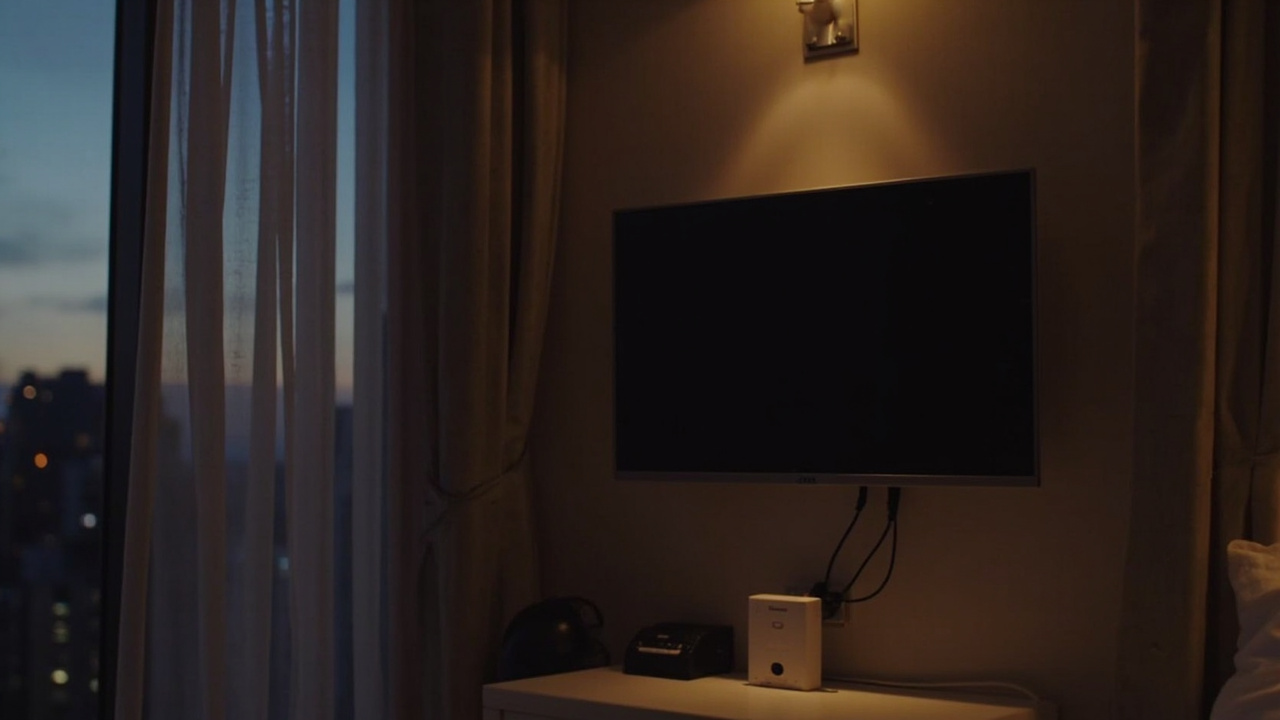
In a modern hotel room installation at dusk, the visible television and furniture conceal a small operator box connected behind the panel. This physical scene explains why thermal design, cable access, network availability, and remote recovery matter alongside display specifications.
A gaming program should define measurement rather than rely on “gaming ready.” The source format, display mode, controller latency, application frame rate, thermal load, and sustained stability need separate acceptance criteria. The DM21T’s stated H.266/VVC [email protected] 4K@120, AV1/VP9/H.265 4K@120, AVS3 4K@120, and H.264 4K@60 should be tied to actual content and application paths. The DM22Q facts instead state AV1/H.265 L5.1 4K@60 with inline AI-SR and no stated NPU TOPS figure.
The hospitality case illustrates the same rule at a smaller scale. DM21P or DM21S may be considered for a concealed room device, but fit depends on physical mounting, wired connection, operator application, remote-control behavior, and service workflow. A buyer should not infer suitability from the word “operator” alone. The correct output is a room-level mock-up or sample test followed by a signed configuration record.
For an IPTV or OTT procurement, the application path matters as much as the codec list. Test the intended application, account state, entitlement path, selected DRM option, source format, and display mode. A successful codec test with local media does not establish that an operator application can obtain licences or sustain playback. The AV1 Android TV box guide supports codec-specific planning, while the application test remains part of acceptance.
What goes wrong after the PO
Field trap
A quotation that lists “4K Android TV” without codec, app, output mode, and acceptance method can conceal four separate limits: decode support, display output, DRM policy, and application behavior. The correction is a one-line media matrix naming source codec, resolution, refresh rate, HDMI mode, app path, and expected result.
The first common divergence is operating system. AOSP Android 14 may be documented correctly while a buyer assumes Google Play, Google Play Services, or an application store are included. Another is DRM: “Widevine L1” needs a device-level and service-level assessment; it does not guarantee every application, content package, resolution, or commercial model will receive a licence. The android tv box manufacturer response should identify the software baseline and actual entitlement scope rather than use the DRM label as a blanket playback promise.
The second common divergence occurs at the network port. “Gigabit” in a deployment note may conflict with a standard RJ45 100M configuration. The correction is to put the exact Ethernet speed and selected option in the BOM, not merely list “RJ45.” A similar issue occurs with optional storage, 1G Ethernet, HDCP 2.2, Dolby Vision, and DTS: these require a selected production configuration, not inferred capability.
Field trap
Marketing labels can outrun the datasheet. Any proposed “8K” claim for DM21T or DM22Q must be rejected because the supplied facts cap output and decode at 4K. The corrective clause is: “No 8K output or decode is claimed; acceptance uses the confirmed 4K mode stated in the production datasheet.”
Customization can also create divergence after the purchase order. If artwork approval, launcher strings, operator credentials, network settings, or remote endpoints are not frozen, a manufacturing delay can become a configuration error. Define who provides each artifact, its format, its approval deadline, and the build identifier that contains it. A supplier that cannot identify the receiving and approval path for those artifacts has not closed the customization requirement.
A practical remedy is a configuration freeze sheet. It should identify the model, RAM/ROM, Ethernet speed, DRM selection, decoding set, output arrangement, launcher build, operator application, remote-control implementation, network profile, packaging artwork, and firmware identifier. Each field needs an owner and approval status. A changed field should trigger impact review instead of silent substitution. This sheet is also the clearest evidence in a dispute involving an android tv box manufacturer quotation.
Another post-PO failure involves certification scope. The buyer may assume that the platform’s existing status transfers automatically after the operator application, launcher, branding, or regional configuration changes. The supplier review should identify which market and certification work applies to the final configuration, which party owns exceptions, and what evidence will accompany shipment. The certification information and compliance information provide the relevant DataMax review points.
Quality evidence can exist but still fail to transfer to the buyer. A supplier may show inspection records without identifying the work order, lot, firmware image, or sample serial number. The evidence must connect the tested unit to the exact order revision and approved configuration. An android tv box manufacturer should not submit disconnected records that demonstrate factory activity without demonstrating the ordered product.
A second factory-side failure is rework that is not represented in the outgoing configuration. A board may pass electrical test after component replacement but return to the line without a documented retest of the affected assembly. The buyer should require rework approval, defect code, replaced-component record, retest scope, and final release sign-off. Without those fields, the inspected quantity does not demonstrate the configuration shipped.
How to choose, step by step
- Name the deployment Record whether the unit is an operator set-top box, IPTV/OTT white-label product, premium UHD or cloud-gaming platform, gaming-oriented device, or integrator-selected component.
- Freeze the media contract Specify source codec, resolution, refresh rate, application, DRM expectation, and HDMI output mode. Reject claims that do not map to this matrix.
- Select the platform family Compare DM21P, DM21S, DM21T, and DM22Q against the supplied processor, operating system, memory, interface, and decode fields rather than generic product labels.
- Choose the customization depth Separate logo printing, boot and launcher work, firmware branches, and joint hardware/software development into distinct commercial lines.
- Define the operating environment Specify wired or wireless connectivity, storage, physical mounting, thermal conditions, accessory behavior, recovery method, and remote-management expectations.
- Attach evidence to acceptance Define sample procedure, production inspection, functional regression, media playback, network test, and the exact documents that must accompany shipment.
- Assign ownership and lifecycle Name responsibility for applications, middleware, BSP, certification, security updates, provisioning, field diagnosis, and end-of-life handling.
- Freeze the production revision Link the approved BOM, artwork, firmware image, operator application, test records, serial traceability, packaging, and shipment release to one order revision.
A pasteable RFQ line should look like this:
Supply the specified DataMax model using the confirmed production SoC, AOSP version, RAM/ROM, Ethernet speed, HDMI configuration, codec set, and DRM option. Include selected boot/launcher branding, operator middleware or OTT application, regional network configuration, production test report, firmware image identifier, packaging artwork, and serial-number traceability. All optional features must be identified by their exact configured designation. Do not claim 8K output for DM21T or DM22Q.
Before sending the RFQ, confirm the intended model and its current datasheet. Use the inquiry channel with that line, or request physical evaluation through sample ordering. A sample review should exercise the declared network port, output mode, codec matrix, boot path, remote-control behavior, and intended app rather than judging only the user interface. The first message should contain the target model, OS baseline, memory and storage, codecs, DRM, HDMI behavior, Ethernet option, branding depth, and destination market.
The sequence can be shortened into an approval flow: deployment, media contract, model, customization, environment, evidence, ownership, and production revision. No step should be skipped merely because a previous program used the same model. A new operator application, country configuration, or production quantity can alter firmware, certification, and test obligations even when the housing and SoC remain unchanged.
The final commercial checkpoint is ownership. Name the party responsible for app defects, middleware defects, firmware maintenance, security updates, device provisioning, certification exceptions, and field diagnosis. A model can be technically identical across two programs while the support outcome differs because the software branch and acceptance boundary differ. That is why an android tv box manufacturer comparison must evaluate the delivery system, not only the unit.
For a term sheet, require a response column beside each RFQ line: “standard,” “optional,” “custom,” or “not supported.” Attach the production datasheet to the response and identify any development activity, certification impact, or lifecycle commitment. This makes an android tv box manufacturer comparison reviewable across competing proposals rather than dependent on sales vocabulary.
Questions to put in the supplier review
Supplier review should test the control system, not only the sample. The evidence chain should connect approved requirements to engineering, material procurement, SMT, inspection, firmware loading, functional testing, packaging, and shipment release. A verbal assurance that the factory performs “full testing” is not an audit trail.
- Trace the build Ask how the purchase order, approved BOM, work order, firmware build, test record, and carton label identify the same production revision.
- Review SMT and inspection Request the documented process for component placement, AOI, defect disposition, rework approval, and line-versus-final inspection.
- Review aging and burn-in Ask which assemblies receive thermal, power, or extended runtime testing, for how long, with what acceptance criteria, and how failures are recorded.
- Review dark-room validation Request a screen or display defect method that covers brightness, uniformity, dead pixels, and any visible panel defect under controlled viewing conditions.
- Review the audit trail Confirm approval authority, non-conformance disposition, serial traceability, retained samples, corrective-action records, and shipment release responsibility.
- Connect configuration evidence Verify that the firmware identifier, operator application, regional settings, network profile, and packaging approval are linked to the same production revision.
- Review exceptions Record every deviation, its owner, due point, acceptance impact, and documentary closure before shipment release.
Ask for one redacted evidence pack as a qualification sample: approved configuration sheet, line-test record, functional test report, firmware identifier, firmware image identifier, packaging approval, and serial traceability. The documents should share one build or order reference. For DataMax, the factory quality process is the appropriate starting point for the review, while certification information and compliance information define the separate market-access workstream.
Ask the supplier to demonstrate traceability in both directions. A forward check starts with the order revision and reaches the matching test record; a reverse check starts with a finished serial number and reaches the work order, firmware build, inspection disposition, and carton label. Gaps commonly appear between final test and packaging, where a unit can be replaced in the carton or assigned an image after its recorded test.
The SMT question should seek control logic rather than a list of equipment names. Ask what happens when AOI detects a defect, who authorizes rework, which component is replaced, what evidence verifies the repair, and whether the unit returns to the affected test stage. The answer should connect the defect code to the released configuration. For a high-volume android tv box manufacturer, this review determines whether inspection results can support a repeatable production claim.
Aging and dark-room validation should follow actual product risk. A concealed hospitality unit needs thermal and remote-recovery evidence; a visible premium product needs display inspection under defined conditions; a networked operator box needs sustained runtime and network-reconnection evidence. The duration and pass criteria should be written into the inspection plan rather than described as “burn-in” without definition.
The review should close with exceptions, not an unqualified approval. List every open deviation, its owner, its due point, and the document required for closure. Questions about Android platform selection can be resolved through the AOSP versus Google Android TV guide, which helps distinguish the operating-system baseline from distribution and service assumptions.
For the glossary entry “android tv box manufacturer,” the final answer is an accountable supplier with a defined platform, reproducible production configuration, tested firmware, traceable evidence, and contractual ownership of deviations. That entry becomes useful only when attached to a model and a signed acceptance matrix. For a deeper commercial review of factory capability, use the manufacturer overview and contact route.
Further reading
- Android TV Box OEM ODM: What It Is and What It Is Not
- Dolby Vision Android TV box guide
- RFQ checklist for device procurement
- Android TV boxes
- Rockchip Android TV boxes
- DataMax DM21P specifications and fit
- DataMax DM21S specifications and fit
FAQ
Is an Android TV box manufacturer the same as an Android TV OEM?
No. A manufacturer produces the hardware, while an OEM owns or specifies the brand, product design, and market requirements. One company may perform both roles. Contracts should identify responsibility for firmware, certification, branding, defects, and lifecycle updates rather than relying on the label.
What does an Android TV box ODM usually customize?
An ODM can customize hardware configuration, BSP integration, launcher, boot experience, applications, regional settings, networking, packaging, and firmware branches. Scope increases with shared design, code ownership, certification work, and update responsibility. Each depth should be quoted and accepted separately.
Does Widevine L1 mean every streaming app will play at 4K?
No. DRM device level, application support, content licence, service contract, decoder path, and display path can each impose a limit. Test the exact application, title, resolution, and display mode. Do not infer an application-specific guarantee from the DRM name alone.
Does AOSP Android 14 include Google Play and Google TV certification?
Not by itself. AOSP is the Android open-source foundation; Google applications, distribution, and Google TV certification are separate deliverables. The supplier should identify which applications and services are preloaded or installed and provide the applicable certification position for the final configuration.
Which DataMax model fits a 4K IPTV operator deployment?
The supplied platform facts identify DM21P for 4K IPTV and operator middleware set-top boxes, with Amlogic S905Y4, quad Cortex-A35, AOSP Android 11, and 2GB / 8GB as the stated configuration. A 4GB RAM configuration and 16/32/64GB storage are listed as optional, while Widevine L1 / PlayReady and HDCP 2.2 are optional. Confirm the production configuration against the datasheet.
What evidence should a buyer request before shipment?
Request records connected to one order revision: approved BOM, work order, firmware image identifier, functional test results, media and network tests, inspection disposition, packaging approval, and serial traceability. Request the applicable certification and compliance records separately, with every unresolved deviation linked to an owner and closure condition.


