

Before the terminology: the decision
Liability follows the contract and the failed control, not the word “supplier.” If an android tv box manufacturer controls hardware, firmware, manufacturing, or OTA release, that party can own the corresponding failure even when another company sells, configures, or operates the fleet. The operator normally retains service-policy decisions, middleware integration, network quality, and customer-device actions unless the contract assigns them elsewhere.
The procurement decision is therefore not “Who is the supplier?” It is “Which party owns each failed control?” Every SKU needs an owner for bootloader signing, AOSP builds, Widevine provisioning, PlayReady integration, operator middleware, update delivery, device identity, and return analysis. A fleet contract that names only a legal supplier leaves material gaps between manufacture, deployment, and support.
Field trap
A device may pass a distributor’s visual inspection and still fail after 30 days because its DRM account, secure-boot policy, firmware version, or update entitlement was never assigned. The commercial invoice proves transfer of goods; it does not prove control of those lifecycle functions.
Before treating a vendor as the accountable owner, obtain the SKU list, target-market DRM checklist, middleware and firmware versions, defined recovery method, and manufacturing evidence. DataMax can supply platform evidence for a video factory audit, but the signed responsibility matrix must identify the operator, integrator, distributor, and manufacturer separately. For broader platform selection, see the canonical guide to the android tv box manufacturer.
A practical decision rule is to reject any quote that cannot answer 4 questions in writing: Which control failed, who owned it, which evidence proves the failure, and who authorizes the remedy? “The supplier will investigate” is not a remedy path. “The manufacturer will provide the build identifier and disposition the returned unit” is actionable because it identifies an artifact, a party, and a record. This approach separates commercial responsibility from technical responsibility while preserving the operator’s need for a single escalation point.
The fleet contract should also distinguish a defective population from an affected population. The first describes the technical failure; the second describes every unit exposed to the same control. A bootloader defect affecting one production batch can remain separate from a middleware entitlement issue affecting the entire deployment wave, even if both appear as “no service” on the device.
The mechanism behind the spec
Fleet accountability depends on a chain of technical controls. A manufacturer may be responsible for board bring-up, Android integration, secure provisioning, test coverage, or OTA artifacts, while the operator controls entitlement policy, middleware releases, network routing, and service monitoring. Contract language must map to that chain rather than assign blanket responsibility to the lowest-cost party.
From physical failure to logical failure
Physical failures are identified through board-level diagnostics, visual inspection, current measurements, port tests, and burn-in. Logical failures may leave the hardware operational but block service: a missing Widevine device certificate, incompatible PlayReady configuration, incorrect operator middleware, or an unapproved firmware image can prevent a complete channel launch. Both classes require a failure-code taxonomy and an evidence package.
AOSP is the relevant operating-system foundation for the platforms discussed here. It does not by itself determine whether a device has operator middleware, a signed release process, or fleet update entitlement. Likewise, Widevine L1 and HDCP 2.2 identify protection capabilities or configurations; they do not assign responsibility for account provisioning, content-service authorization, or recovery.
The contract’s control objects
A workable responsibility matrix identifies at least 8 control objects:
- Electrical and mechanical conformance to the approved specification.
- Android build provenance and signing authority.
- Bootloader, secure-boot, and update-policy configuration.
- Widevine and PlayReady provisioning requirements.
- Operator middleware integration and compatibility.
- Device identity, enrollment, and serial mapping.
- OTA staging, rollback, and fleet reporting.
- Root-cause analysis, return disposition, and corrective action.
For each object, name the responsible party, acceptance test, evidence location, response time, escalation route, and field population affected. The android tv box manufacturer should not claim responsibility for a failure controlled by the operator’s entitlement server. Conversely, a supplier should not disclaim a board, build, or provisioning defect merely because another party completed installation.
Evidence must survive the shipment
The source of truth should connect a carton label, hardware revision, firmware build, bootloader version, DRM configuration, middleware version, and test record. Without that chain, a “fleet-wide” conclusion may actually mix hardware revisions, operator packages, or deployment waves. This is especially important where an update reaches only part of a population: the update denominator becomes as important as the defect denominator.
Control objects also have different diagnostic signatures. A board-level defect generally follows a hardware revision, production date, or component batch. A signed-image defect follows a bootloader or firmware identifier and often disappears after rollback. An entitlement defect follows device identity or service account. A network defect follows access path, DNS, multicast, or site configuration. The first analytical step should therefore be symptom classification, not attribution based on the loudest stakeholder.
A service-recovery clause should specify how failed units are quarantined, how logs are preserved, and when a replacement may enter service. If replacement units require new certificates or enrollment, that work must be included in the restoration plan rather than assumed to follow automatically. The operator should also specify whether a returned unit remains under warranty administration while technical analysis proceeds, without confusing commercial processing with the root-cause obligation.
Which DataMax models actually sit here
Model selection determines which party can credibly own platform work. The table below states only the supplied DataMax facts; options not listed remain subject to the production datasheet.
| Model | Positioning | SoC and OS | Memory | DRM | Connectivity and I/O |
|---|---|---|---|---|---|
| DM21P | 4K IPTV / operator middleware set-top box | Amlogic S905Y4, quad Cortex-A35; AOSP Android 11 | 2GB / 8GB; 4GB; 16/32/64GB optional | Widevine L1 / PlayReady / HDCP 2.2 optional | HDMI 2.0b out x1; USB2.0 x2; TF; S/PDIF; 3.5mm AV; RJ45 100M; Wi-Fi6 2x2 + BT5.4; DC 5V/2A |
| DM21S | 4K Android TV box for IPTV/OTT white-label | Amlogic S905Y5, quad Cortex-A55; AOSP Android 14 | 2GB / 16GB; 2/4/8GB; 16/32/64GB optional | Widevine L1 / PlayReady optional; Dolby Vision/DTS | HDMI 2.0b out; S/PDIF; AV; USB2.0 x2; TF; RJ45 100M (1G optional); Wi-Fi6 2x2 + BT5.4 |
| DM21T | Premium UHD / cloud-gaming box | Amlogic S905X5, quad Cortex-A510 (ARMv9); AOSP Android 14 | 4GB / 64GB family options | Widevine L1 / PlayReady optional | HDMI 2.0b out; no HDMI in; USB2.0 x1 + USB3.0 x1; TF; S/PDIF; AV; RJ45 100M (1G optional); Wi-Fi6 + BT5.4 |
| DM22Q | Gaming-oriented Android TV box | Amlogic S905X5M, quad Cortex-A55 up to 2.5GHz; AOSP Android 14 | 4GB / 64GB; 2/4/8GB; 16/32/64GB optional | Widevine L1 / PlayReady optional; Dolby Vision/DTS | HDMI 2.0b out; USB2.0 x2; TF; S/PDIF; AV; RJ45 100M (1G optional); Wi-Fi6 2x2 + BT5.4 |
The field evidence should match the selected model. For DM21P, the supplied facts support an operator-middleware route with 2GB / 8GB as the stated configuration and specified memory options. HDCP 2.2 is optional, so the buyer must not treat it as a standard feature until the order configuration and production datasheet confirm it. An android tv box manufacturer offering an operator model should also identify who signs the middleware image, who owns device provisioning, and who executes rollback.
DM21S and DM21T both use AOSP Android 14 but have different SoCs and interface combinations. That difference affects platform validation: a passing build on one cannot be transferred as evidence for the other. DM21S lists AV1 and H.265 [email protected] 4K@60. DM21T lists H.266/VVC [email protected] 4K@120, AV1/VP9/H.265 4K@120, AVS3 4K@120, H.264 4K@60, and inline AI-SR. Its HDMI output is 2.0b, with no HDMI input. The stated decode ceiling must remain separate from any display-capability discussion.
DM22Q provides a different performance configuration: Amlogic S905X5M, quad Cortex-A55 up to 2.5GHz, 4GB / 64GB as stated, and AV1/H.265 L5.1 4K@60 with inline AI-SR. No NPU TOPS figure is supplied. The buyer should ask the android tv box manufacturer for the exact production configuration and acceptance media rather than infer features from a platform family name.
The decoding lists also affect the acceptance workload. A box can be electrically sound and still fail the operator’s service test because the selected media profile, operating mode, or output configuration was not exercised during approval. Procurement should therefore name representative streams and expected behavior in the order, rather than accepting a general statement that the SoC supports 4K. For optional features, the purchase order should identify whether the option is populated at the factory or merely supported by the design.
This distinction matters when fleet evidence is audited. A production report showing 4K playback must identify the model, RAM/ROM configuration, firmware, middleware, display mode, media profile, duration, and sample basis. Without those fields, the result can support only a narrow statement: one identified test configuration completed the recorded scenario.
Deployment scenarios and the spec each needs
Deployment context changes which control creates the greatest liability. A retail operator prioritizes operator middleware, entitlement, and mass enrollment. A system integrator may own installation but depend on the manufacturer for every device-level defect. A venue deployment may use static Ethernet, fixed signage, or centralized control, reducing Wi-Fi variability but increasing the cost of a configuration mismatch.
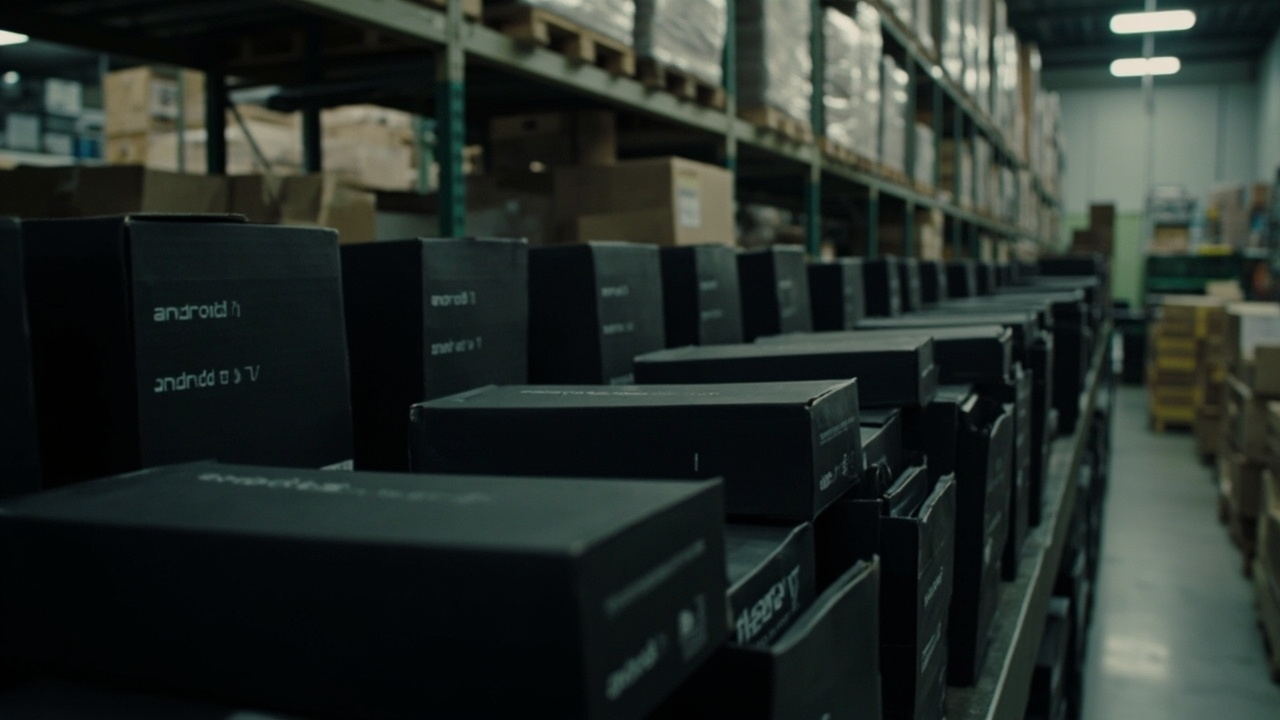
A fleet rollout exposes repeated hardware variants and software states that a single sample can conceal. The warehouse image represents the transition from accepted units to an accountable installed population.
| Situation | Primary requirement | Model direction | Evidence to require |
|---|---|---|---|
| Operator IPTV deployment | • Operator middleware • Device enrollment • Stable identity mapping | DM21P direction | • Middleware compatibility list • Enrollment test • Serial and firmware correlation |
| IPTV/OTT white-label programme | • AOSP Android 14 integration • 16GB stated configuration • DRM and display-option control | DM21S direction | • Signed build procedure • DRM checklist • Configuration audit |
| Premium cloud-gaming use | • 4K@120 decode list • USB3.0 availability • Latency-oriented validation | DM21T direction | • Media playback matrix • Thermal and stability log • No-HDMI-in design confirmation |
| Gaming-focused Android TV deployment | • 4GB / 64GB stated configuration • 4K@60 media validation • Controlled update route | DM22Q direction | • Sustained playback record • Release and rollback test • Configuration approval |
For an operator, the selected android tv box manufacturer should support staged enrollment: provision a controlled batch, verify service access, then expand after the failure rate is compared with an agreed baseline. The denominator must be devices deployed, not units shipped. For an integrator, define the point at which ownership transfers after burn-in and middleware installation. For a venue programme, use the same hardware revision throughout a display group where visual output, remote-control behavior, and recovery procedures must remain consistent.
A common error is to choose the platform before defining the operating boundary. If one party controls firmware signing, another controls network access, and a third performs installation, the contract must state how logs, serial numbers, and failed units move between them. Otherwise, each party can correctly report that its own work passed while the installed fleet still fails.
Three additional scene-level controls deserve separate acceptance language. First, an operator rollout needs a pilot that is representative of the production image, entitlement service, home network, and remote-control procedure; a laboratory-only trial does not validate deployment. Second, an integrator handoff needs an installation record stating who applied middleware, activated identity, and verified each port. Third, a venue deployment needs an image freeze for each display group, because uncontrolled application changes create a configuration defect that is indistinguishable from a hardware failure.
The fleet denominator must also be frozen at each handover. The operator may accept 500 deployed units, but the distributor may ship 600 and retain 20 for installation. A failure rate calculated against all 600 is not the rate for the operated population of 500. The evidence record should state shipped, received, installed, activated, and in-service counts, along with the excluded units and reason.
The selection sequence that removes rework
A controlled selection sequence converts fleet liability into testable decisions. Start with the operating boundary, not a chipset list.
- Map the deployment owner Name the operator, integrator, distributor, and manufacturer roles. Assign each of the 8 control objects to one accountable party and one backup reviewer.
- Freeze the device population Record the exact SKU, hardware revision, memory configuration, OS, firmware baseline, middleware, middleware version, and regional content profile.
- State the protection requirement Identify Widevine, PlayReady, and HDCP requirements as mandatory, optional, or not applicable. Tie each to an ordering configuration and provisioning owner.
- Define acceptance tests Specify power, interface, network, playback, boot, upgrade, rollback, and recovery tests. State pass criteria, sample method, and the population denominator.
- Set the evidence package Require AOI records, aging results, dark-room records, audit evidence, release artifacts, and failure-analysis records before shipment or deployment approval.
- Agree the remedy path Define quarantine, root-cause deadlines, credit or replacement authority where applicable, corrective-action approval, and retest scope.
These lines can be pasted into an RFQ:
“The android tv box manufacturer shall identify the responsible control owner for board assembly, AOSP build provenance, bootloader signing, Widevine/PlayReady provisioning, operator middleware integration, OTA staging, rollback, device identity, and failure analysis. The delivery package shall include the approved SKU/hardware revision, memory configuration, firmware and middleware versions, AOI and aging evidence, relevant target-market certification records, and serial-to-test-result correlation.”
Before naming a model, request a android tv box manufacturer product response against this sequence. Confirm whether the proposed platform is AOSP Android 11 or Android 14, whether an optional feature is actually ordered, and which changes require a new validation cycle. Memory variants are not software-equivalent: a storage increase may change the bill of materials, partition layout, image, or recovery path. Confirm against the production datasheet.
Add a change-control line to the RFQ: any change to SoC, memory configuration, boot components, firmware baseline, middleware version, packaging, or target market must identify which previously completed tests must be repeated. The change record should state the affected serial range or future build identifier and the party approving release. This converts an open-ended revalidation dispute into a defined engineering task.
The sequence should also identify which evidence travels with the shipment and which remains in the factory system. Shipment-level records normally need the configuration identity, release identity, test disposition, open deviations, and serial or population correlation. Detailed process data may remain with the manufacturer if it is accessible during an audit and can be tied to the same production run. The buyer should not accept either an unstructured file transfer or an inaccessible repository as a complete audit trail.
For a fleet requiring service continuity, add a replacement-unit test. Provision a spare from the same approved process, place it into a representative deployment, enroll it, launch the defined service path, and execute the recovery operation. The pass criterion is functional restoration under the fleet procedure, not a successful boot screen. This test exposes certificate, identity, middleware, and pairing failures before the first in-service failure.
Failure modes that reach the field
The costliest failures usually arise where an ownership boundary was assumed rather than documented. A unit can pass SMT and electrical test but fail later because the shipping image does not include the operator middleware, the DRM configuration was not commissioned, or the rollback path was never exercised.
Field trap
Do not call a mixed Android failure a single hardware defect. Compare serial prefix, hardware revision, RAM/ROM configuration, bootloader version, firmware build, middleware version, and deployment wave. Without those fields, the failure rate cannot support a supplier finding, and a firmware rollback may expose only part of the affected population.
Hardware and thermal instability
Repeated reboot, interface failure, or unstable playback can originate from soldering, power delivery, thermal behavior, connector quality, or media compatibility. The manufacturer’s evidence should show how the symptom was reproduced. A retest without an approved unit and documented setup is not evidence of correction.
A useful retest preserves the original symptom and the original configuration. It should record input source, power condition, ambient and observed thermal context, duration, media stream, firmware, middleware, and every intervention. If a board is replaced, that fact belongs in the analysis; replacement without the failed component prevents recurrence analysis.
Configuration and provisioning drift
Optional DRM, network options, and regional settings create quotation ambiguity. A quoted Widevine L1 path does not establish that device-level provisioning was completed. A stated 100M RJ45 option does not establish whether a 1G configuration was ordered. Confirm against the production datasheet and the packing or production record for each shipment.
Provisioning drift can survive a unit’s movement through the chain. A factory device may receive one identity, the distributor another, and the operator another. A manufacturer’s certificate service, operator enrollment service, and middleware configuration service may each be valid individually but incompatible as a set. The acceptance record should therefore capture all 3 identities and their expected relationship.
Software-update regressions
An OTA release can change signing, permissions, codecs, middleware integration, or recovery behavior. The party that authored and signs the update should retain test and rollback evidence, while the party operating the update service owns deployment scope and rollout records. A common consequence of unclear ownership is a rollout that stops at one failing pilot unit even though the defect rate is unknown.
A robust rollout uses a controlled cohort, a fixed rollback artifact, and a stated deployment threshold. It also defines whether failure at the boot stage, service-launch stage, or content stage blocks wider rollout. These are different technical boundaries: bootloader or image-signing failure points to release control; middleware launch failure points to integration; content authorization failure points to account or service configuration.
Middleware and entitlement failures
Operator middleware may fail because of package, API, entitlement, identity, or server dependencies. These outcomes should not automatically be attributed to the android tv box manufacturer. Conversely, an incomplete signed build or wrong device configuration should remain within the manufacturer’s assigned control. The responsibility matrix should name the diagnosis owner and evidence-transfer deadline.
The handover protocol for diagnosis must specify which artifacts each party can export. Hardware and AOSP diagnostics may require privileged access, while entitlement logs may remain on operator systems. The fleet process should allow those artifacts to be combined without exposing credentials or personal data. A named analysis coordinator is more useful than a generic support mailbox because the coordinator can route artifacts to the failed control’s owner.
Recovery and spare-pool mismatch
A replacement unit can become unusable if device identity, entitlement, certificates, or remote-control pairing does not transfer. Define whether the operator re-enrolls a replacement or the manufacturer must preserve identity continuity. Test a replacement from the same fleet procedure and measure restoration time, not merely whether the replacement powers on.
Other field failures include missing serial labels, mixed firmware baselines in one site, undocumented LAN or Wi-Fi assumptions, and localized power or connector problems. None can be assigned from a generic symptom alone. The analysis record should connect each failed unit to its acceptance data, and each acceptance record should remain retrievable for the period needed to investigate the deployed population. The android tv box manufacturer should be asked which records it can retrieve directly and which must be supplied by the operator.
The evidence trail from SMT to shipment
An evidence trail must connect process control to the delivered unit. The purpose is not to create a large document set; it is to show which physical and logical controls were executed, against which configuration, and with what result.
- Incoming and board control Record component traceability and the applicable incoming inspection result for the approved production configuration.
- SMT and AOI verification Link AOI inspection to board and panel identifiers. Document exceptions, disposition, and the retest result rather than merely marking a pass.
- Assembly and firmware loading Capture the hardware revision, RAM/ROM selection, firmware identifier, bootloader state, and the unit serial number used by the build process.
- Functional and interface testing Record the tested port configuration, network path, playback profile, remote-control behavior, and required operator middleware conditions.
- Aging and dark-room verification Retain the defined duration, environmental condition, sample or population basis, interruptions, and failure disposition. Confirm the exact production protocol against the production datasheet.
- Audit and release gate Review the audit record, open deviations, approved configuration, release identity, and traceability status before shipment authorization.
- Shipment correlation Link cartons or pallets to serial ranges, hardware revision, firmware and middleware package, test records, and destination deployment wave.
DataMax’s factory-audit request should specify the SKU, hardware revision, memory configuration, target market, and required evidence set. The review should determine whether SMT, AOI, aging, dark-room, firmware-loading, and audit records can be correlated to the shipped units rather than reviewed as disconnected folders.
The same evidence can resolve liability after deployment. A failure ticket should arrive with the serial number, hardware revision, firmware build, bootloader version, middleware version, install image, log window, symptom category, and deployment wave. If the android tv box manufacturer owns the relevant build, it can reproduce the release under controlled conditions and return a signed analysis. If the failure lies in operator entitlement, the operator must provide the corresponding service evidence.
A controlled review should sample across the evidence chain rather than select only easy-to-reach folders. For example, the buyer can select 1 shipped serial, 1 carton label, 1 final test record, 1 firmware-loading record, and 1 AOI reference, then trace them in both directions. The forward trace proves what controlled the selected unit; the reverse trace shows whether the tested unit was the unit shipped. Any broken link becomes an evidence-gap action before volume approval.
Release control also needs closure status. An audit finding should identify its affected configuration, containment action, owner, and approval state. “Closed” should mean that the defect was corrected and the defined retest passed, not that a document was uploaded. For fleet liability, this distinction determines whether the same issue can legitimately appear in a later shipment.
The request for a video factory audit through DataMax’s factory-quality process should follow the selected SKU rather than use a generic checklist. Ask the factory to demonstrate the path from the production line to the released unit, including firmware loading, functional test, aging, dark-room, exception handling, and shipment correlation. The evidence must remain specific to the hardware revision and release under consideration.
Options placed side by side
Supplier types differ in control depth. A trader can source catalogs, but accountability may remain fragmented across brands, factories, and logistics providers. A sourcing agent can coordinate procurement, yet control over firmware, testing, and correction depends on delegated authority. A single-line factory may offer focused manufacturing and repeatable process for a defined product. A full-process OEM/ODM can integrate hardware, software, test, provisioning, and lifecycle controls, but only if the contract assigns those responsibilities explicitly.
The editorial scores below are a planning aid, not measured supplier performance. They describe expected control alignment for a repeat-volume hardware programme, not an audit result.
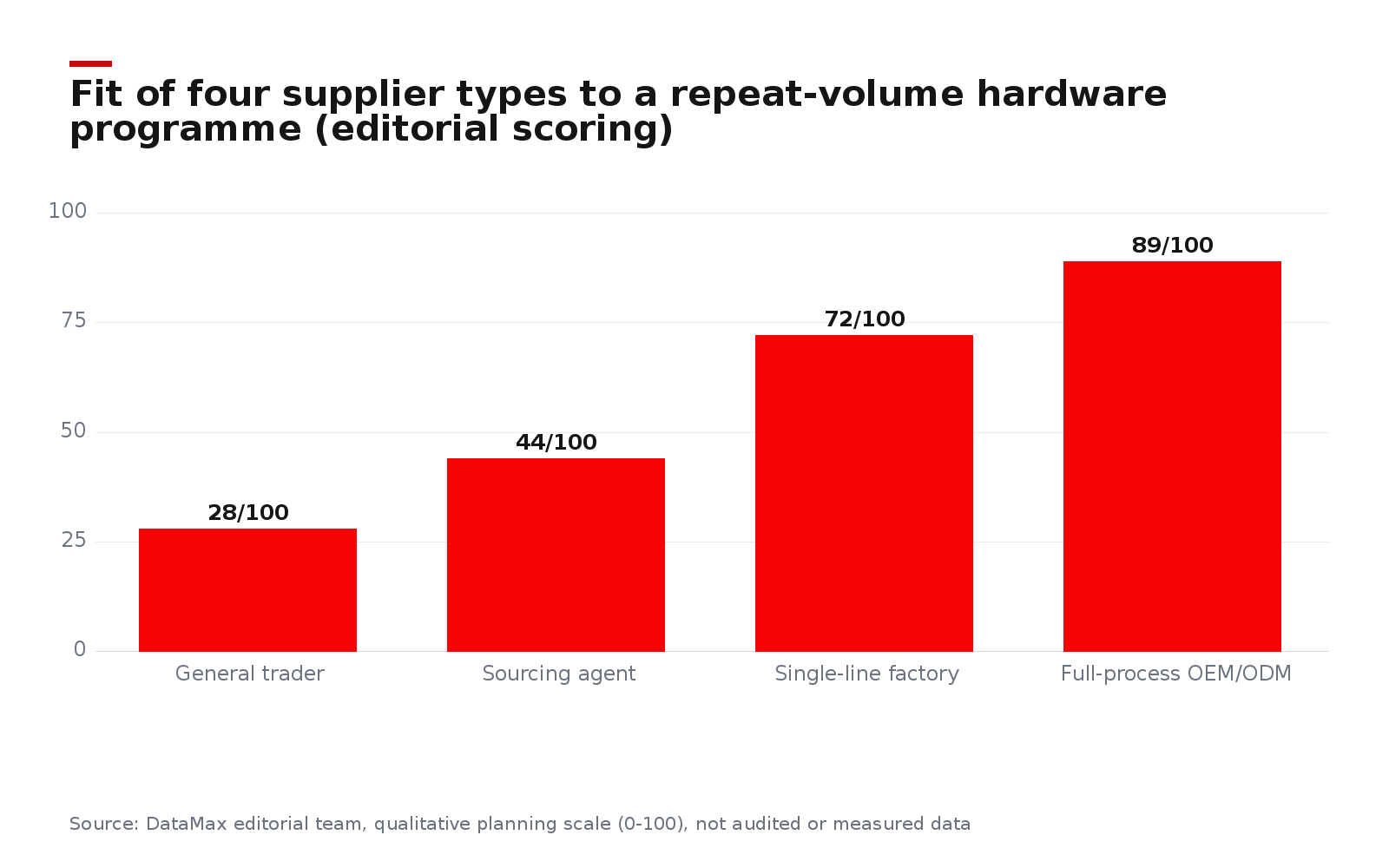
The same figures, in searchable form:
| Supplier type | Editorial score |
|---|---|
| General trader | 28 |
| Sourcing agent | 44 |
| Single-line factory | 72 |
| Full-process OEM/ODM | 89 |
Source: DataMax editorial team, qualitative planning scale (0-100), not audited or measured data.
| Control area | General trader | Sourcing agent | Single-line factory | Full-process OEM/ODM |
|---|---|---|---|---|
| Specification control | Catalog-led | Brokered | Defined product line | End-to-end engineering |
| Firmware provenance | Supplier-dependent | Requires escalation | Platform-led | Contracted release process |
| DRM and middleware accountability | Often divided | Coordination role | Case-dependent | Named control owner |
| Manufacturing evidence | Document-dependent | Audit-led | Factory-controlled | Traceable release gate |
| Fleet recovery | Multi-party routing | Escalation-managed | Defined for core product | End-to-end remedy path |
A full-process arrangement reduces the number of handoffs, but it also requires a clearer specification. Before naming an android tv box manufacturer, compare the quotation line by line: who signs firmware, provisions DRM, integrates middleware, executes OTA, retains logs, and authorizes corrective action. Confirm which DataMax model matches the required baseline; use the platform table as the starting point rather than assuming one configuration covers every market.
The comparison should extend into contract governance. A fragmented model may require separate orders, acceptance templates, and escalation routes for hardware, software, and logistics. A full-process model may reduce interfaces, but the buyer still needs named approval authorities and release gates. For either model, require a responsibility matrix with the 8 control objects, a change-control process, a failure-code taxonomy, and an approved evidence list.
Entry-tier and commitment-tier options also differ in flexibility. The entry route may use a catalog platform with fewer project-specific controls and a simpler evidence package; the commitment route may support an approved hardware revision, release management, middleware integration, provisioning, and fleet recovery. These are procurement structures, not performance claims. The buyer should match its governance resources to the complexity of the fleet rather than buy a higher-control process for a fixed installation or omit controls for a managed operator rollout.
For the final approval, ask DataMax to package the SKU list, target-market certificates, middleware and DRM checklist, hardware revision, and required manufacturing evidence for engineering and procurement review. The team can then email [email protected] with those 5 attachments and request a fault-accountability review before volume commitment.
Further reading
- Guide android tv box manufacturer
- H.265 HEVC Android TV box guide
- Widevine L1 certification guide
- Dolby Atmos Android TV box guide
- TV box vendor selection checklist
- DataMax DM21P specifications and fit
- DataMax DM21S specifications and fit
FAQ
Who is liable when an Android TV fleet fails?
Liability follows the failed control and the contract. The manufacturer may own a board, firmware, provisioning, or manufacturing defect; the operator may own entitlement, network, middleware, or rollout faults. The purchase order and responsibility matrix must identify each control owner, acceptance test, evidence requirement, and remedy procedure. A supplier label alone does not determine liability.
Is a single-line factory suitable for a large Android TV deployment?
A single-line factory can suit a stable, tightly defined product, but fleet accountability still depends on firmware ownership, configuration control, traceability, and support authority. A buyer should inspect how the factory identifies hardware revisions, retains test evidence, handles returns, and escalates middleware or DRM problems. Larger deployments generally need clearer release gates and replacement procedures.
Should Widevine L1 be written as a guaranteed fleet feature?
Only if it is included in the approved order configuration. Widevine L1 capability does not establish device-level provisioning, account status, content authorization, or successful playback. The RFQ should separately require platform support, production provisioning, key-holder obligations, test evidence, and the named party responsible for certificate failures.
What evidence should be requested before shipment approval?
Request the approved SKU and hardware revision, RAM/ROM configuration, firmware and middleware identifiers, SMT and AOI records, aging and dark-room results, audit findings, shipment serial correlation, and open-deviation dispositions. Records must be linked to the same unit or controlled population. Unconnected test folders cannot establish whether the shipped configuration was the configuration that passed.
Can one DataMax model cover every operator and OTT deployment?
No single platform configuration should be assumed universal. DM21P targets 4K IPTV and operator middleware set-top-box use; DM21S targets 4K IPTV/OTT white-label use; DM21T targets premium UHD and cloud-gaming use; DM22Q targets gaming-oriented Android TV use. Their exact configurations and optional features must be confirmed against the production datasheet and approved order.
How should a buyer resolve a fleet-wide failure after deployment?
Freeze the affected deployment wave, preserve logs and failed units, and stratify results by hardware revision, memory configuration, bootloader, firmware, middleware, and install image. Assign diagnosis ownership under the responsibility matrix. The responsible control owner then reproduces the fault, records corrective action, and defines the retest population and rollout threshold before recovery continues.


